Bristol born artist, Guy Denning final part of his trilogy of exhibitions (It’s the final part of his trilogy of exhibitions interpreting Dante’s The Divine Comedy; PARADISO. Inferno and Purgatorio, which were shown in Bologna and New York) interpreting Dante’s The Divine Comedy: PARADISO has just happened at Signal gallery and has delighted us by his intensity and display of technical art skills.
Each piece in this show is boiling with emotions and dynamism and mirror the ecstatic route to a place of resolution and rest for Dante, the route to heaven that is for Dante.
A quite large part of the show present a series of female portraits appearing soft and fragile but transposed in some sort of tragedy thanks to the sketchy technique used by the artist, although achieved mostly with oil which is remarkable. The artist inspiration comes from Beatrice, Dante’s long dead love, who is the central figure in the poem and who symbolises feminine purity and vulnerability.
Denning’s characters are floating, dancing, tangling with each other and give you a sense of dizziness. The color palette is dark and deep like the multitude faces expressions disseminated all over the canvases. The perspective used for some of his pieces is also remarkable and is an invitation to dive into his vision.
Guy Denning will definitely arouse the viewer’s curiosity about Dante’s life and has given us an unique and modern representation of Dante’s 14th century world.
New York Comic Con 2012 has just happened and we are bringing you our top 5 favorites toys designs – this event is the East Coast’s biggest and most exciting popular culture convention.
Comics, graphic novels, anime, manga, video games, toys, movies, and television fans are mad about the stuff on display.
New York Comic Con is the second largest pop culture convention in America and the only one that takes place in the comic book, publishing, media, and licensing capital of the world — Gotham City.
Artist: Dai Tran “Pandit” and “Bitsumo”
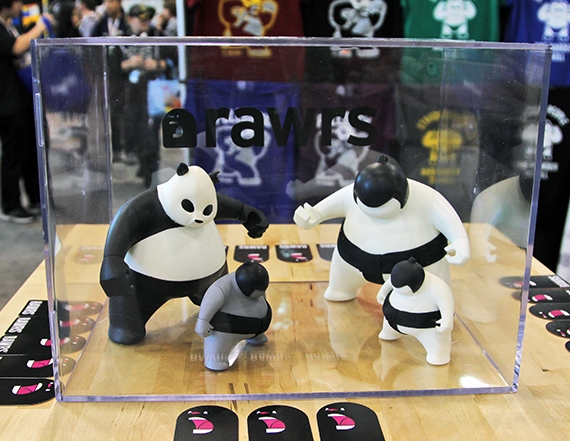
Dai Tran’s big-bellied custom action figures “Pandit” and “Bitsumo” — one a sumo wrestler and the other a panda — have a mythic rivalry that plays out on the graphic t-shirts he’s created for complimentary apparel line, as well as in his line of figurines.
Artist: Kaitlin Juarez and Maxwell Yax
“Madknits”
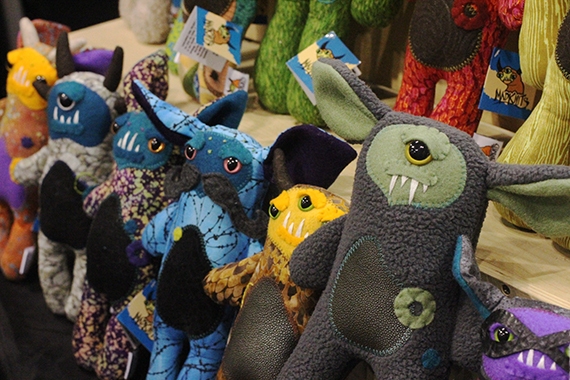
A certain ARTINFO editor (who will remain unnamed) couldn’t resist buying one of these heartbreakingly cuddly monsters herself. Each one is handmade, and comes with a backstory about their assimilation to planet Earth, based on the Madknits comic series.
Artist: Smoko
“Toast USB”
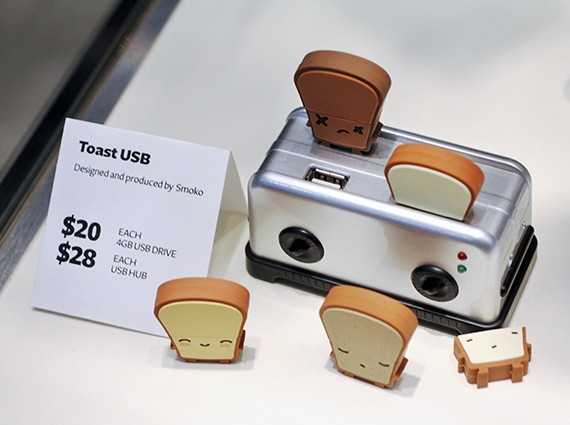
We wish we had the whole set of genius 4 GB toast-shaped USBs for our office. “Butta,” “Ry Ry,” “Crisp,” and “Tato” fit into a toaster hub, which also includes an SD card reader and works with any flash drive.
Artist: Mr. Munk
“Buddha B Pissed”
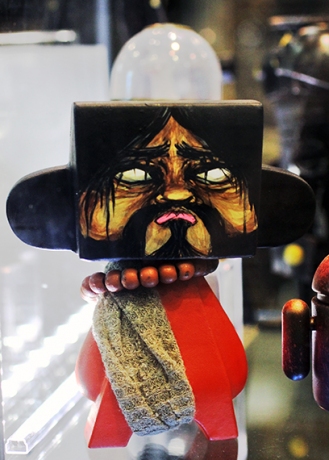
According to its creator, this trio of Buddha action figures — complete with big block heads and crazy eyes — was sent out into the world to rid it of its evils, absorbing bad energy and repurposing it.
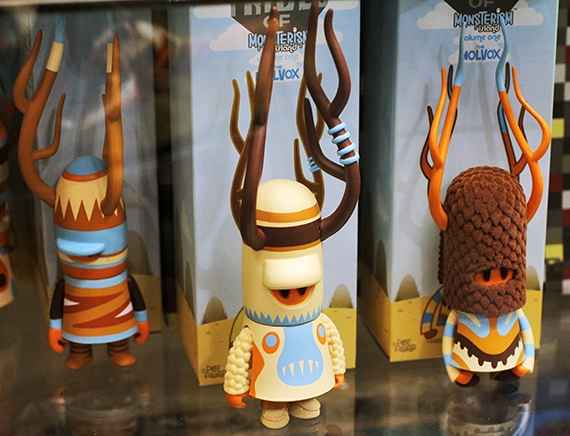
Artist: Pete Fowler/Molvox
“Tribes of Monsterism Island Vol. One”
The natural earth tones used by artist Pete Fowler for his “Molvox” series of devilish tribesman are perfect; details like the felt applique on a textured helmet and the toothy face painted on another figurine’s jacket make his little guys unique finds when bought
Taken from the Blouin Artinfo website, check there for photo credits
Sarah Hervey has a note in her sketchbook, it reads, “Wittgenstein maintained every statement rested on unproven assumptions and illogical associations”.
With regard to language there are four problems outlined by Bertrand Russell in his 1922 introduction to Wittgenstein’s Tractatus Logico-Philosophicus:[1]
First is a problem of what actually occurs in our minds when we intend to mean something.
Second is the relationship between thoughts, words and sentences and what they refer to.
Third is a problem of constructing sentences to convey truth rather than falsehood – in a logical sense rather than in a factual sense of true and false.
Fourth, what relation must a fact have to another in order to be capable of being a symbol for it.
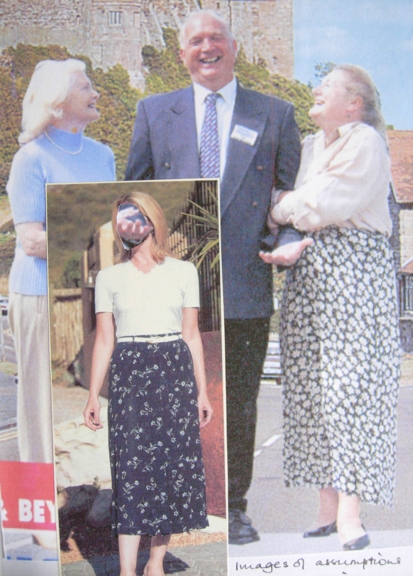
According to Russell’s essay, the fourth problem is what concerned Wittgenstein and it is at the heart of Sarah’s note to herself, which is positioned in relation to this image in her journal:
Images of Assumptions, (c) Sarah Hervey, sketchbook collage
“In the language of everyday life it very often happens that the same word signifies in two different ways – and therefore belongs to two different symbols – or that two words, which signify in different ways, are apparently applied in the same way in a proposition [a statement]…[t]hus there easily arise the most fundamental confusions.”[2]
Ludwig Wittgenstein
The problem of clear communication is further complicated by psychology, the first of Russell’s four problems with language, and identity, the second. What does it mean to be vulnerable? We all know what it feels like and so we feel we can describe and understand it. But can we? David Minton a fellow exhibiting This ‘Me’ of Mine artist, asks Sarah if she thinks his male vulnerability is an attribute of feminine vulnerability, wondering “if the view of ‘masculine’ is dependent on the view of vulnerable as ‘feminine’?” It’s a compelling question.
Jane Boyer: Much of the vulnerability you are interested in and you explore is based in gender issues and ageing. Can you tell us what it is particularly about vulnerability, experienced through gender and age, which interests you?
Sarah Hervey: I think there has been a lot of research into why women live longer on the whole and have a resilience somehow, yet the way we are supposed to attract men is to be vulnerable, the weaker sex, so there’s all that dynamic which is interesting. Because I have this idea about skin and how your history shows on your face, so if you’ve had a life where you’ve felt vulnerable it will begin to show. As your body gets older you just appear more vulnerable because your skin gets thinner, your bones aren’t as strong, you find it more difficult to hold your head up straight and keep your back straight and so your body starts to cow. The different way men and women deal with that interests me; how we feel about that is the internal part of skin, then the way society looks at you is the external part. I mean, the essence of being female or male is different and I feel it is important to struggle to understand more precisely the positions of men and women within these boundaries. My point of view is as a woman. I can’t understand my own vulnerability and the vulnerability of women without understanding the vulnerability of men.
Read more of our interview, Without Any Voice. If you are enjoying reading about the issues involved with This ‘Me’ of Mine, follow the blog by clicking the ‘follow’ button under the heading Follow blog via Email at the bottom of each page and engage with us by leaving a comment, follow us on twitter @thismeofmine or like our facebook page, facebook/ThisMeofMine.
VETA GORNER at the BEN OAKLEY GALLERY, Greenwich
Preview Evening 9th November 2012, 6.30pm – 9.30pm
A fresh and exciting solo exhibition of new works by Veta Gorner. Veta is a multi-instrumentalist high quality Printmaker. Using her own Press she creates unique etchings, lithographs drypoint, screenprints, colographs and processes that have not even been named yet.
Technically excellent her works are strong in colour and delicate in content, they carry a dense raw energy that are aesthetically balanced, some built up from layers of the finest hand made papers with waxes and thread woven through, it is in the detail that you can read the time consuming journey that goes into each individual piece.
Ben Oakley comments: “This new body of work sees Veta experimenting on an open brief with no real narrative, some natural abstract fluid forms effortlessly merging with bolder but subtle architectural influences.
Veta shares time between her London & Swedish Studios always observing the cultural differences in each country and around the world, she is engaged and fascinated in the parallels of life as they overwhelm and delight us simultaneously.”
VISITOR INFORMATION
BEN OAKLEY GALLERY
9 Turnpin Lane, Greenwich, London SE10 9JA
DLR: Cutty Sark Greenwich ( 2 minutes walk )
Overground Train: Greenwich Station ( 5 minutes walk )
Opening Times: Thursday –Sunday 11-6pm
Monday –Wednesday by appointment.
All media enquiries /invitations: contact Ben Oakley:
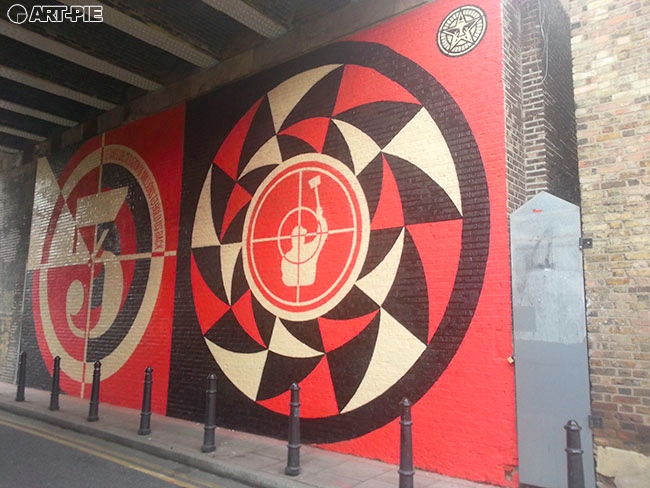
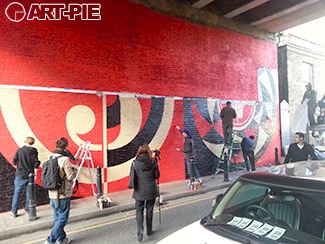
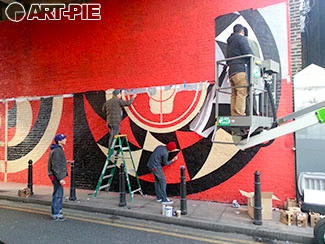
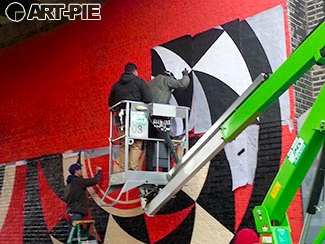
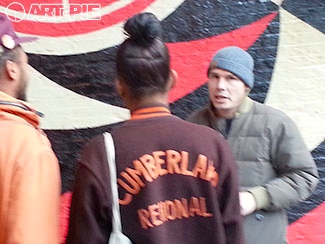
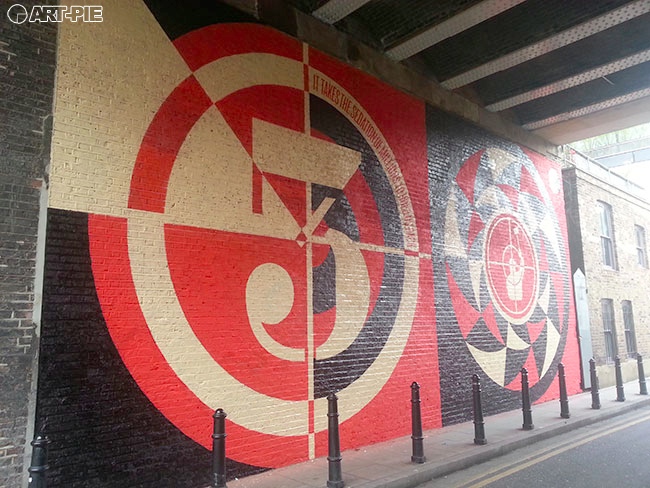
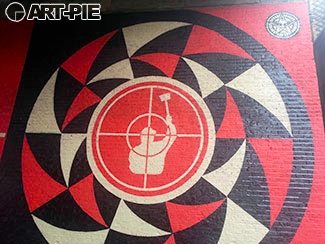
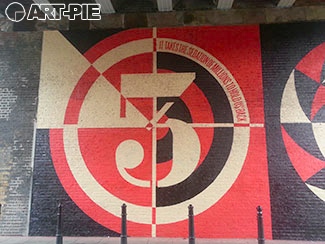
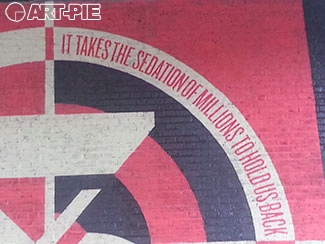
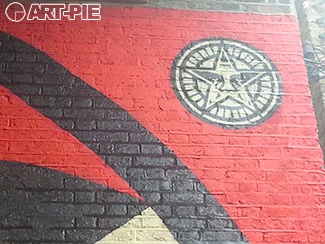
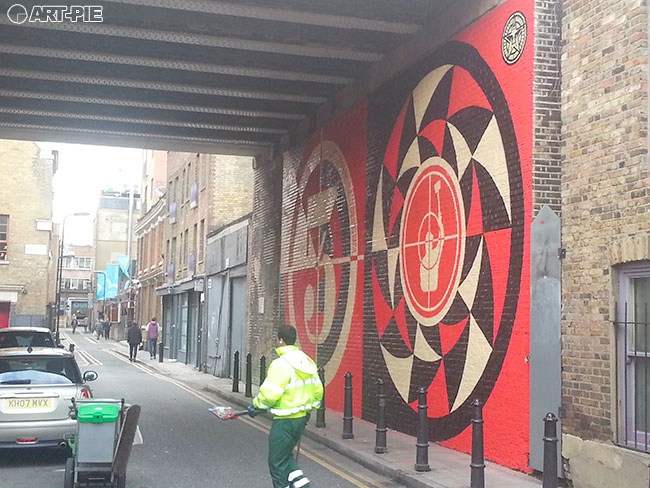
We were lucky enough to be at the right place at the right time last week end to see Shepherd Fairey and his team at work. The team worked on a huge piece which we went and see again today. Enjoy the pictures below.