
Wire sculptures by David Oliveira

Is “wire sculpture” becoming a thing? Well we met Robin Wight and his beautiful Fairies Wire Sculptures and we were astonished by the outcome.

Meet David Oliveira and his animal wire sculptures. His manipulation of wire to create a zoo of mind-boggling animal sculptures is just crazy. have you ever tried to make something out of the wire thingy around a champagne cork? Yes you did .

David Oliveira | Art-Pie

But take it to the next level and you get what might look like for some some sort of doodle or drawing. We have not had the chance yet to see the artist’s work in front of our eyes but we hear that the what looks like a 2d piece is an intricate yet clever use of wires to shape 3d wildlife animals.

What the artists says –

“My work 99% comes from my memory the other 1% is wire. Very ecological, right? Why wire? Because [it] is a line that can [stand] against gravity… Because [it] is naif, easy and spontaneous.”

David oliveira | Art-Pie

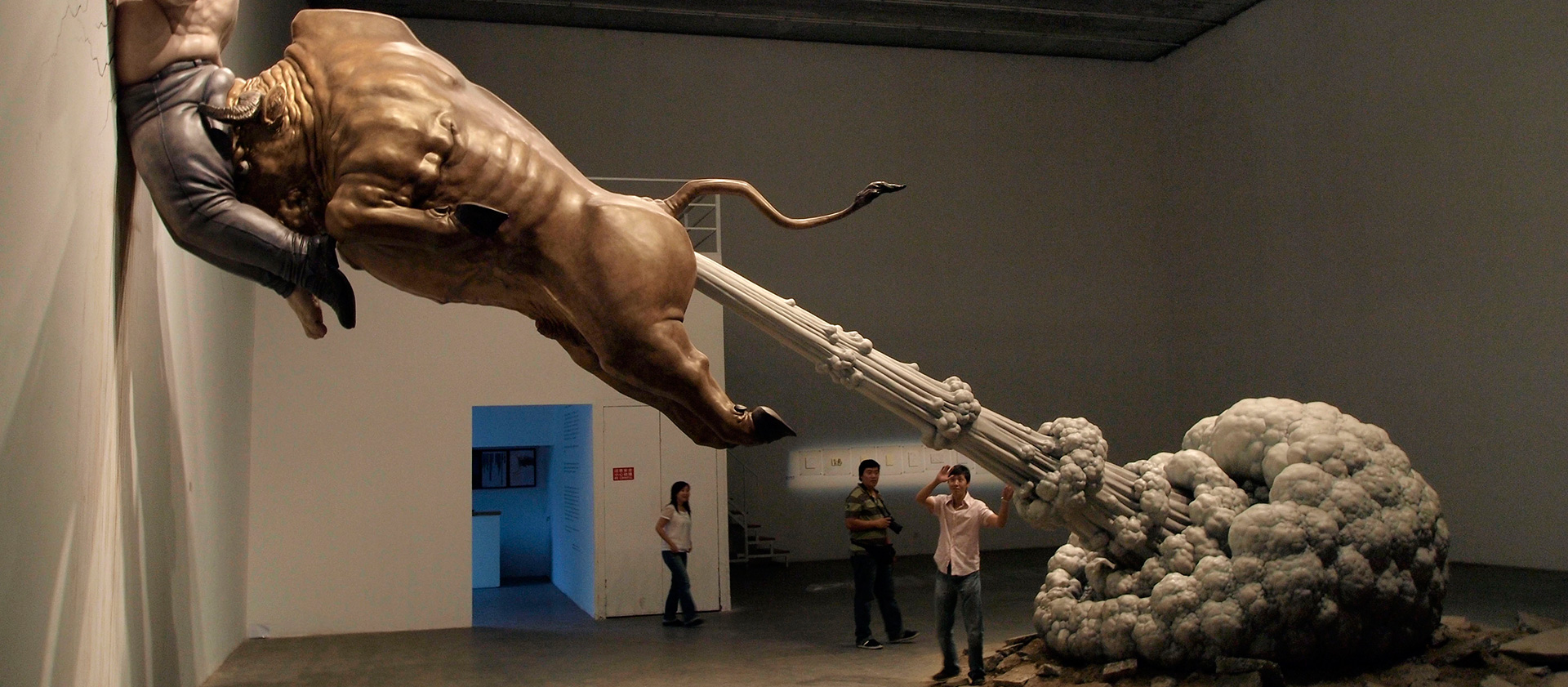
Gordon Cheung at Room: multi media artist

I always find fascinating when an artist can juggle between medias or techniques, when artists can be as varied as Gordon Cheung is. It is definitely a sign of open mindedness and in this case also talent.

Pyrographics, spray paint, oil, acrylics, sculpture, animation… Gordon Cheung seems to explore everything in is art. THE JOURNEY (ink, acrylic gel and spray paint on canvas), BEAR and BULL (both being acrylic gel and spray on canvases) are definitely my favorite pieces. Acrylic gel is superb to get incredible texture and relief. Continue reading Gordon Cheung at Room: multi media artist

We talked to Dave White, ahead of his new show ‘Critical’

Dave White | Art-Pie
Dave white in his studio in Dorset

We at Art-Pie have enjoyed following the work of contemporary British Artist Dave White for many years. We are drawn to the energy of his explosive and dripping paint style, and moved by his primary subject matter of animals.

This November 4th – 28th sees Dave’s new show Critical open at the Loughran Gallery in Chelsea. Focusing on animals from the critically endangered list and near extinction, or the tiers just below, it’s the labor of an artist impassioned by the plight of animals.

The Art-Pie team had the pleasure of interviewing Dave this past September at his studio in Dorset, exactly half-way through the creation of his new collection.

Dorset in South West England is a landscape dominated by spectacular nature, and it is breathtaking. We toured his studio, conducted a very insightful interview, and saw prints from several past collections, including his recent shows Albion based on native English wildlife, and Apex which documents great white sharks.

“I love cities…. I am in London all the time but I can’t live there. I love Dorset. There’s a tranquility, a complete silence that just works for me. [It’s a] headspace that ….almost cements the 1:1 relationship you have with the medium that you work with…there’s no distraction for me. It’s just me, and that.”

We too felt the strength and power of the natural surroundings, and in learning more about Dave’s formal background as an artist, came to understand how it shaped the progression of his career. Dave graduated with a BA (Hons) in Fine Art (Painting) from Liverpool John Moores University, and was “blessed” as he describes, to be a working artist since his first show in ‘94 at the Royal College of Arts, which was his initial animal series.

Dave White | Art-Pie
Some of Dave’s pieces for his next show ‘Critical’ at Loughran gallery

Dave is an experienced artist of 24 years who knows himself, but has incredible humility.

“You never ever stop learning. And the most important thing is, never ever ever ever give up, ever. The best advice I can give people is discover yourself. Don’t look at anybody else’s work. Just know in your heart and soul that you want to make something. [It’s ok to be influenced] Don’t become obsessed with other people’s work. Do your own thing. Do what makes you happy.”

Our drive to Dorset from London was stunning as we enjoyed the beautiful winding country roads, rolling hills with stunning coastlines, and multiple stops into the medieval ruins of several castles and churches. It was impossible to not feel the power of his environment, and the nature evidenced in his work. He told us his passion for animals comes from childhood, and how he still views them in awe with the “…same wonderment from being a child, amazed that we live in the same world.”

Dave describes his interaction with the wild animals in Dorset as “…blessed and lucky that I see almost daily stags, foxes, owls”. That influenced him to create his Albion series which focused on native English species, and really cemented his incredible affinity for animals. The more research he did, the more his passion grew, as he realized so many of these animals are being pushed to brinks of extinction. He described his shock at headlines touting articles like “40 Million Mobile Phones Sold in the Last Quarter”, while the demise of entire species attracts so little attention.

Dave White | Art-Pie
Dave White talking to us in his studio

The depiction of animals has been a near constant throughout Dave’s career, allowing him witness to the forefront of their sad demise. So many factors have contributed but the crux is modern times; Dave cites climate change, habitat destruction, and hunting amongst others. While maybe not intentional, Dave’s work has come to immortalize these animals. Brave use of color, eyes that jump off the canvas and grab the viewer, it all comes together to heighten their heartbreaking destiny. Dave’s shows such as Natural Selection, Apex, Albion, and now his greatest effort yet Critical, raise this awareness.

Dave White | Art-Pie
Dave White is also a big fan of video games

While Dave described how the peace and inspiring nature of Dorset allows him to connect with his craft, he admits “I would never paint in silence”.

Dave told us excitedly that he enjoys an eclectic variety including Jazz (his father was a jazz drummer), finds himself stuck in an old-school time warp of ‘91 – ‘02 hip hop, and loves ‘93 – ‘07 jungle, and drum and bass.

However more than any other style, it seems Dave is moved to his core by classical music which he feels “approaches perfect“, describing the extreme volume as he would “...blow my head off in here, playing Appalachian Spring by Leonard Bernstein”.

Dave approaches his painting as a serious craft and a consummate professional. He told us multiple times, “You’re only as good as your last piece.” Arriving at his studio by 7am, he fully prepares himself before he starts the work. Does the sketch, lays underpaints, mixes his colors. But then he loses himself in a zone he likens to a meditative state. He locks the door, he is completely unattached to thought, and that is how he produces, “….its an organic process”.

“I don’t actually think about painting when I’m painting, at all. ….I just basically know I need to do this, and do that, and how I get to the end I have no idea. I just go into a zone, ….it’s just a spontaneous thing. And I guess the older I’ve got, the more personal it it for me.”

dave-white-critical-8We were curious about his inspirations, about the artists he admires and why. Japanese artist Takashi Murakami was his first mention, describing “I love his color, love his palette. When I saw them in the flesh, it literally blew my mind. …It’s an incredible skill to be able to put down what he does, the way he does… and it looks almost like it’s a print.”

We discussed Murakami’s long-standing collaboration with Louis Vuitton, and Dave described the partnership as “incredibly brave on both sides. Collaborations work if they’re genuine, if they aren’t one-sided and they are the best of both”. Dave speaks from experience as he has past collaborations with Nike and Jordan, as well as MTV.

Dave went on to describe his greatest admiration for Van Gogh, “A man who did it his way, tried to fit in with convention, but said you know what, fuck it. I’m just going to do what I do, and I’m so blessed to be able to do it.” Dave revealed his personal affinity for that, and how he’s read his diaries and is “…completely blown away by him”.

Dave described his second favourite artist to be Picasso:

A man who reinvented himself throughout his career. The best work is that he did before he died, when he’s 80 years old. ‘I live in a castle. I’ve got a pet owl living above me. And I’m just going to paint and really not care what it looks like.’ There’s a life, and a zest, and a kind of beauty in the naivete of those late works, and I love it.”

Animals continue to shape Dave’s career as he explores different collections over the years, but always with his signature style of explosive and expressive colors, vibrant and dripping. The plight of animals and their march to extinction upsets him greatly, and his style conveys the strength of that conviction, “I want people to be confronted by these things, and look at them as they are looking at it”.

dave-white-critical-6

We support Dave and his artwork, and the message it drives to raise awareness for so many animals at risk. Dave offered much wisdom during his interview and we came to understand the heart and soul depicted through his paintings is very much his own. In parting wisdom, we leave you with this from Dave:

“Do your own thing. Do what makes you happy. Never ever give up. It’s not quick and there’s no formula. Produce things that are honest, true to yourself. High quality. Make the best shit you can. Do what is yourself, be yourself.”

You can find Critical running this November 4th – 28th at the Loughran Gallery in Chelsea.

What – ‘Critical’
Where – Loughran gallery, 43 Cadogan Gardens SW3 2TB
When – 4 to 28/11/ 2015

Multiplied fair at Christie’s

Andrew Mc Attee - Spin - Courtesy of Eyestorm

Coinciding with Frieze Art Fair in what is undoubtedly the most important week in the London Contemporary Art scene calendar, Multiplied Art Fair presents the perfect forum to scope out emerging artistic talent.

In collaboration with over thirty London galleries the art fair will be hosted by Christie’s and will offer contemporary art editions in all its manifestations, from prints and photographs, to artist’s books and 3-D multiples. Continue reading Multiplied fair at Christie’s

RUN has hit the walls of Village Underground

Artist RUN just finished his piece on the walls of the Village Underground project space and has kindly sent in a few pictures which are shown below. This commission came as a bit of a surprise for the artist since the guys at VU rang him at the last minute and asked him whether he would like to fill the 6 days off advertising gap by painting the outside walls

The job took about 5 hours and depicts one of classic RUN’s feaure already seen across London streets and beyond.

RUN at Village Underground | Art-Pie

RUN at Village Underground | Art-Pie

RUN at Village Underground | Art-Pie

Immaterials: light painting WiFi networks

Light Painting WiFi is the creation of Timo Arnall, Jorn Knutsen, Einar Sneve Martinussen. Their work explores the invisible terrain of WiFi networks in Oslo urban spaces.

They put together a four-meter tall measuring rod with 80 points of light reveals cross-sections through WiFi networks using a photographic technique called light-painting. By the simple action of walking down streets, they are able to pick up the thousands of WiFi signals and with the help of a long exposure camera, transform them into wall, barriers of lights.

Beyond the art aspect of this work, this technique has also a research purpose as the data collected is used to evaluate the quality of the Oslo wireless networks.

Immaterials: Light painting WiFi from Timo on Vimeo.

Related links
> Flickr set

Markus Kiebel at Arch402 – Inside Complexity

The first London solo exhibition by German artist Markus Keibel sees a continuation of his interactive site-specific installations, as featured in PORTIZMIR 2 (2010), the triennial of contemporary art held in Izmir, Turkey. Exploring semantic roots and the poetry of materials, Keibel’s work brings to surface enigmatic, abstract forms.

Markus Kiebel

Since 2005, the Berlin-based artist has not only developed conceptual site-specific installations, but also an abstract idiom using different forms of human traces. The perception of viewers is the issue addressed by Keibel, whose current work investigates how colour interacts with viewers. His sculptures, paintings and works on paper draw their elements from simple materials, often using pigmented glass and acrylic colours to modify their mode of operation.

Created on-site especially for the Arch 402 Gallery, Inside Complexity will reveal a large-scale floor sculpture, designed for viewers to walk over and leave traces as they move.  Characterized as an ever-changing form, the four concentrated circles—created using different coloured pigment powders—shift and disperse throughout the exhibition venue, causing the colours to lose their intensity. As part of the exhibition, the transformation of Keibel’s ever-changing floor sculpture will be captured both in a time-lapsed video and on canvas.

In order to create these final works, the gallery space will be closed the day following the Private View (11th Feb) when Keibel will use the transformed pigment areas to create big canvases (170 x 280 cm), revealing the transcribed traces of human movement.

Keibel’s interactive installations are less focused on how interaction with the work evokes feelings in the public, but rather, with how these feelings act on given materials, as the pigments ultimately seem to reveal a sentimental beauty. Rendering the pigments in his own specific mode of representation, Keibel not only prefigures subjectivity in the abstract but also his own subjectivity, from a viewpoint that questions the prescriptive experience.

Words from Necmi Sonmez

Where – ARCH 402 GALLERY | Cremer Street, E2 8HD | Tue-Fri 11-6
When – 12 February – 18 March 2011 / Private View 10 February 6-9pm

Democracy Outside – street performances and activism

Words by Clare Cochrane

ART-PIE - Democracy OutsideDemocracy outside or street performance that blurs the boundaries of art and activism, and makes social movement real

A group of people show up in a public space with a banner, placards, leaflets, and a loudhailer. Two people each take a placard and stand a few feet apart, stretching the banner between them. The group stand between the placards, and one person calls out a question about a current political issue through the loudhailer. The huddled people look at each other, and start to move, some towards one placard, marked ‘No’, some towards the other, marked ‘Yes’. The loudhailer is passed around and people take turns explaining their point of view. As the dialogue progresses, people move about, shifting their positions. Slowly passers by gather and join in, and the space for re-imagining democratic exchange grows, as we open our imaginations in response to one another’s questions and reflections, and play at politics together.

ART-PIE - Democracy outside

Opening up public space is right now more urgent than it has been for some time. As the journalist Anna Minton has documented, we have seen an increasing and increasingly rapid privatisation of public space over the last decade or so, – it as as though we are witnessing a 21st century wave of enclosures. In Oxford, where Democracy Outside was first developed and performed, Bonn Square  in the city centre has been declared a ‘licensed venue‘ , so that spontaneous public art and political protests are no longer legal there. The irony is strong: Bonn Square, the traditional site for political gatherings in the city, was named for democracy after the capital of the new West Germany when the two cities were twinned in the early cold war; it hosts the city’s war memorial listing men who died in the first world war too young to vote when the franchise stood at 21; and today it’s the preferred ‘hanging out’ location for excluded, disenfranchised youth who feel unheard and ignored.

Street art has long had a vital role to play in opening up public space. Yes, it brightens up a dull place, but it also demonstrates that it is possible to think beyond what is presented by the authorities. Engaged performance can go further – breathing life into an anaesthetised space. Participatory performance, involving the spectators as performers, as actors, goes another step further still. So much public space has been etherised, deadened, and depoliticised – whether through privatisation or, as in Oxford, through deliberate attempts to stifle and ultimately mute spontaneous expression. People using such spaces become numb, paralysed, stupefied.

Democracy Outside shows a way to change this – in Democracy Outside the spectator / participants break the stupefying spell, activate their imaginations and themselves, and with their voices break the silence. It opens up the public space and invites the public in to experience the possibilities for open democratic dialogue – and to feel how it it is to literally change one’s point of view – to break free of the old back and forth, black vs white of prescribed political exchange.

The artist Shelley Sacks has offered a redefinition of ‘aesthetic‘ as meaning ‘enlivened being’. The challenge is to create, in our anaesthetic public realm of commodified communication, de-politicised debate, and deadened senses, a place where people can be in this (beautiful) state of awareness and connectedness.

James Baldwin said “artists are here to disturb the peace”: if peace means the peace and quiet of deactivated, desensitised space, then this has possibly never been more necessary than it is at this moment in time. Artists and creators – we have a job to do! Let’s do Democracy Outside!

Democracy Outside is touring England in June and July – for more details and to join the dialogue online go to https://network23.org/demo2012/.

STREET ART ENCOUNTERS