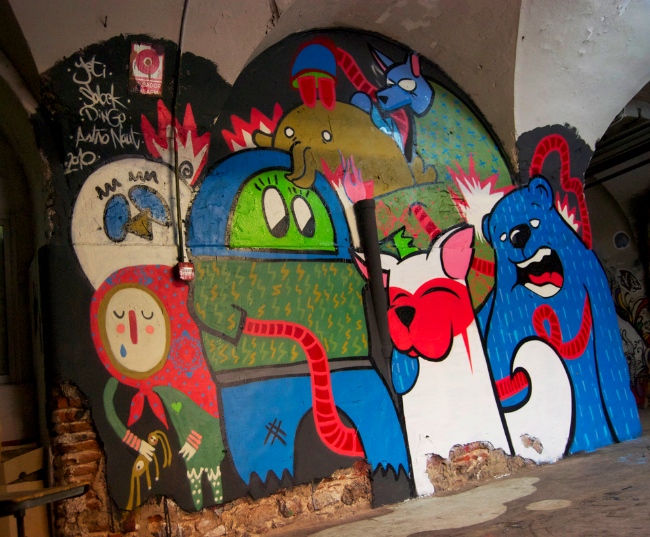
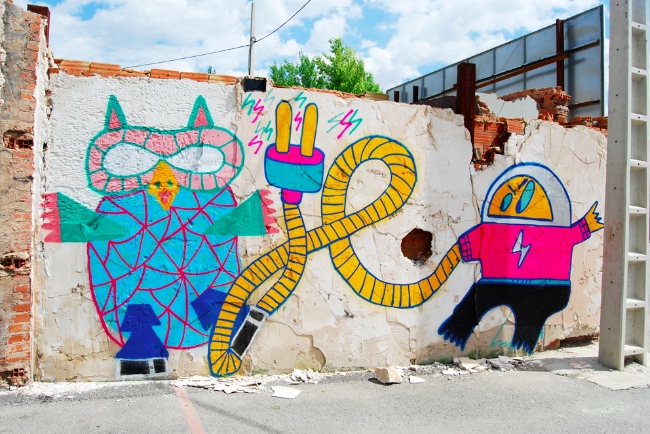
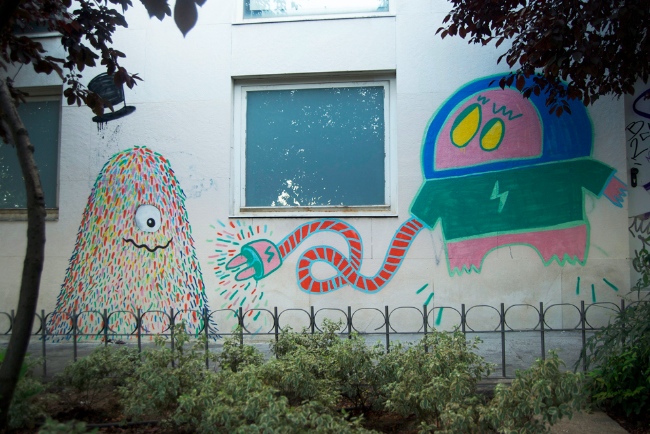
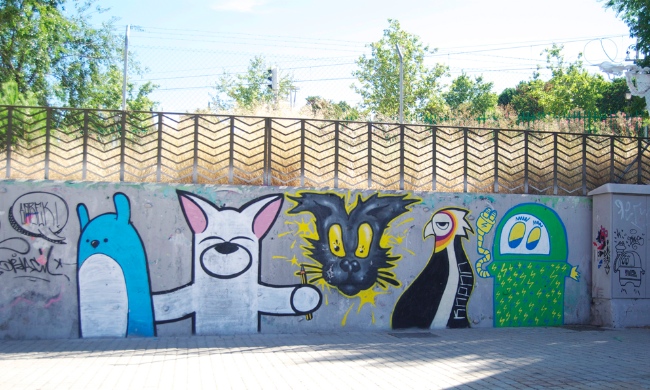
Another stroll along the mighty Brick Lane and another set of street art which we woud like to share with you. The LUDO and CRANIO pieces were our favorites. Which one is yours?


C215

LUDO (left) | #CODEFC


CRANIO


Another stroll along the mighty Brick Lane and another set of street art which we woud like to share with you. The LUDO and CRANIO pieces were our favorites. Which one is yours?


C215

LUDO (left) | #CODEFC


CRANIO


We met Fintan Scott-Magee originally from Brisbane and try to find out a bit more about his liking, it seems, for rubbish and bins in his art.
A-P: Tell us about yourself in a few words?
FINTAN MAGEE: My name is Fintan Magee, born in Brisbane Australia. I have been writing for 10 years now but I started to move away from traditional letterforms about 4 years ago and started to paint more canvas and street art. Really I’m just trying to have as much fun as possible with my art while I am still young and stupid enough not to know better.
A-P: What is your process/approach when making graffiti/streetart/art?
FM: I prefer to paint strait onto walls using oils, acrylic and of course spray paint. I like to paint in abandoned buildings a lot so I can relax and paint for as long as I want, the problem is my city is growing very quickly and becoming so developed that there is a shortage of empty and forgotten spaces. In my city almost everything painted on the streets is buffed within a week so I don’t really do many paste up’s or stickers any more, they say my city is clean but I just find it sterile.
A-P: Bin bags, rubbish seems to be an element that you like, why is this?
FM:The rubbish is just something thats developed over the last few months because I was painting still life images of things that have been forgotten or left behind on the streets, I guess I like to add depth to what may be considered bland or boring subject matter and not worth painting. I believe that we live in such a throw away and progressive society now that we overlook the beauty in many things that we consider expendable.
A-P: Where/what do you look for inspiration?
FM: I guess I look everywhere for inspiration, I think as an artist its important to take in the simple things around you, popular culture, nature, the city, your friends, etc. Keep looking and you will eventually find inspiration and influence where you least expect it.
A-P: Any upcoming shows/projects?
FM: I am travelling to Sydney and Melbourne in June for some group shows and to do some walls, I also have a Solo show at Jugglers gallery in Brisbane in August and another solo show in Melbourne’s Rtist gallery in November. After that I think another overseas trip is on the cards, possibly to the Americas. I have been back in Australia for two years now and I am starting to get pretty itchy feet.
Thank you to Fintan for taking time for this interview
Pictures below of some of Fintan’s works. More on this website: www.fintanmagee.com


Cybersecurity brand Kaspersky Lab announces a significant new creative collaboration with London-based Street Art luminary Ben Eine
‘Back to Work’, an artist film exploring Ben Eine’s art practice commissioned by Kaspersky Lab.
Specially commissioned artwork by Ben Eine will feature on the 20th Anniversary edition of Kaspersky Lab’s market-leading Kaspersky Total Security v.2018 internet security product
Celebrating the 4th year of Kaspersky Lab’s support for the Moniker International Art Fair, the world’s largest Urban Art event, Ben Eine’s creative partnership with Kaspersky Lab was showcased through a large scale installation at the Moniker Press Preview on Thursday 5th October
Eine’s specially commissioned artwork includes a new typographic ‘K’ produced exclusively for Kaspersky Lab.

Hogan Rebel recently released his book Rebel journey: Dream-Believe-Create
, narrating the career of a dozen of famous modern rebels, and defining the founding values of the Hogan Rebel lifestyle collection.
We were asked to look closely at one of these artists, Paola Pivi, to come up with a quote for an upcoming video. You can see the video below.
Here are a few words from the artist herself –
What’s your definition of rebel?
Not a sheep, not a wolf.
Who do you consider rebel?
Somebody who creates their own system.
What’s your dream?
Freedom and peace, which I lost the day I saw somebody was about to abuse a person I love and I started a trial to try to defend him.
In what you believe?
Now that I see on my own skin how unbelievably hard it is to try to stop bad actions in other men, I respect whoever did something like this.Why man creates?To develop our brain.
——-
The Rebel Journey, a book by Hogan Rebel
Fabio, a.k.a. Cranio is from São Paulo, Brazil and have been spraying around since 1998.
Still to have a show in the UK, I am sure it is just a matter of time, Cranio is getting more and more attentionI in his native country. Armed with sprays, latex paint, brushes and paint rollers, he leaves his imagination flow and his passion for indigenous art blossom.
Enjoy a selection of some of his works below. The first photograph is his latest work. We love the Brazilian pareo!
See more of Cranio’s street art


Want to see art outside of the commercial galleries? Or maybe like me you have lofty dreams of starting your own art collection. This weekend take a trip to South West London from 25 November to the Wimbledon Art Studios, Winter Open Studios Art Show. The open show sees artists opening up their studio spaces this weekend, giving the public the chance to explore a treasure trove of new works. There’s an eclectic mix by up and coming, as well as established artists, photographers, ceramicists and textile designers.
Community and the artist

The Wimbledon Studios aim to provide a spring board for working artists, which couldn’t be apt in today’s dire financial climate. The studios are the largest, single site art studio complex in London and Britain. This fantastic project is not merely about the singular artist and the creative community within, Wimbledon Art Studios aim to give local people the opportunity to view and appreciate contemporary art, whilst building links with the resident artists.
The opening night was bustling with proud parents, artist’s friends and locals. The last open show attracted over 5,000 visitors and I suspect they shall hit they figure or more this year.
On the preview night studio workers were happy to talk about the spaces and I was impressed by the colour map brochure produced for the show. Plenty of friendly guides and artists were on hand when I lost my bearings in the rabbit warren of corridors and stairways, so be warned you may loose yourself but find an interesting artwork in the process!
The entrance, which bridged the two buildings in a temporary structure, displayed some key pieces including Kate Kelleher’s eye catching painting, and a sculpture by Kevin Herlihy who uses found and recycled mediums. There were also some small board works for sale to raise money for the studios upkeep. At £55 a go, I decided to snap up a board by Jayson Lilley. Other artists you should stop by at – Darryn Eggleton‘s amazing animal paintings and Alison Pearl‘s delicate and seemingly impossible objects made from paper.
Inside the spaces
As I tottered around with my new art work I explored the studios which are spread over 2 areas. The main Red Studio building, originally a paper warehouse, opened with just 6 artists renting spaces in 1993. Now, the original warehouse consists of over 100 studio spaces and in addition there are now 60 studio spaces in a newly, purpose built ‘Blue Studios’ building, on the same site. On 1st November 2011 an additional 55 brand new studios were opened in a reclaimed section of the warehouse. Now the site has over 200 artist tenants. The close proximity of the studios make it feel homely, it felt like I was stepping into a person’s private space, almost like their bedroom, a definite plus side away from the clinical commercial gallery spaces.
The artist and the studio
Is a studio site like the one in Wimbledon an ideal place for an artist to gain recognition though? And do the resident artists actually like the makeshift space in the built up industrial estate in Wandsworth? I asked Idun Eustace, an resident artist at the Wimbledon site who is displaying her pieces for the show.
Idun has been at the studios since 2007 and first exhibited during the autumn show. Idun lectures in life drawing and oil painting for EAL, Ealing, West London. Her works of semi-abstract still life evoke many influences from the Norwegian landscape where she was born and brought up.

What do you think of the new studio space that opened in November 2011? So how does it compare to other, more formal, settings you’ve shown at? Such as gallery spaces/fairs?
The new space (as a whole) has got a nice feel to it & is much more spacious than the studios in the old Red Studio building – Although my new space has no natural light ,I feel this doesn’t matter so much, as I look upon it as a challenge to see how it changes my work. There are studios with natural light but I chose this one for the space as I want to run life drawing classes from there as well as paint.
Do you feel the studios are successful in terms of building a creative hub for emerging artists and also for artists to sell their work too? Or do the more traditional roots of art fairs and private galleries, like the Affordable Art Fair, work better?
I think it’s a little hit and miss sales wise – sometimes you sell and others not. The good thing about the studios is that they don’t take a commission on sales whereas fairs, such as AAF and other London Galleries take 50 %. It does give merging artists as well as more established artists a great platform to sell their work.
Where do get your ideas for pieces? Whilst travelling around London, or more abstractly?
I draw a lot and source ideas almost everywhere – e.g. If I go in to London on the train (with my sketchbook) I will look out of the window and take a mental picture and draw it immediately, or when I’m on holiday (usually to Norway), I always have my sketchbook (and camera) handy. I also sometimes draw and paint from memory so these may be more abstract – I look on the drawing process this way; if you’re an artist you ought to draw as its part of the process of painting. Painting is really drawing with your brush.

You are trained in many different disciplines, painting, printmaking, life drawing, photography, graphics, illustration & textiles. Do you or would you ever incorporate these into you pieces?
I do use photography as reference only, whether it be a design ref or a colour reference – I have used printmaking in my art but not currently – I do however like the way Munch used print making as reference/addition in his art and have recently been looking into this. I’m quite interested in African tribal art textiles. I have also been toying with the idea of introducing burlap/hessian in my work but at present this is embryonic only. I am looking at the work of artists like Tapies and Sandra Blow for inspiration.
You are quite active on Twitter, do you feel artists have to embrace this more so now? Have you felt the need to use it more?
I feel the use of twitter is essential to reach out to a wider audience and think that one’s got to advertise oneself, no-one else will do it for you and hopefully one’s twitter followers will RT and thus reach more people – so it can only be a good thing. You have to grab opportunities as life is too short.
Idun’s works feature at the open show till 27 November and she is also planning to run classes that will be available to artists at the Studios as well as outsiders, contact her here for more information idun@blueyonder.co.uk. Follow her on Twitter @idunart
The Open Studios Art Show at the Wimbledon Art Studios is open to the public till 27 November Friday 2pm – 10pm
Saturday & Sunday 11am – 6pm. For more information about the show and the artists see click here.

Of all the public art on display at the St Pancras station in London (UK), one piece stands out.
I am talking about the bronze statue called The Meeting Place that proudly stands at the south end of the upper-level beneath the station clock. The numbers: 9-metre (29.5 ft) high, 20-tonne (19.7-long-ton; 22.0-short-ton), impressive isn’t it? But have you been near it and noticed the frieze, a myriad of smaller sculpture works all around the plinth?
No? I did and was genuinely seduced by it.
This whole sculpture is the work of British artist Paul Day, and is intended to evoke the romance of travel through the depiction of a couple locked in an amorous embrace. However this is for the main part of the work, the part that everyone can see from the window of the train…. but, what about the work located at the pedestal? At first glance, there is nothing romantic.
The frieze was actually added by the artists in 2008 and caused a stir as it was branded as ‘controversial’. It indeed originally depicted a commuter falling into the path of an underground train driven by the Grim Reaper (understand ‘Death). The image was one of many featured on a frieze for a controversial sculpture planned for St Pancras in London.
A spokesman for the company said: ‘The frieze as originally suggested will not go ahead and work on it has stopped.”
In his defence, the artist replied that the image was created in a tragi-comic style meant to be a metaphor for the way people’s imaginations ran wild. He added: ‘The imagination and real life are often intermingled.”
Day revised the frieze before the final version was installed and it can be seen today. No trace of Grim Reaper but a multitude of faces with strong or bold expressions, often hard to pin point. Are they sad, happy, tired, pained? I do not know, but what I do know is the artist mastered conveying feelings in this work.
Have you seen this work? What do you think?
If you’ve not seen it, please do as it’s worth the trip. Enjoy the photographs below in the meanwhile.


Emma Stibbon’s work in this exhibition looks at history and collapsed empires. The shadow of classical antiquity cast on Western civilization ominously stretches into present times – the city is a symbol of both memory and amnesia.
Her focus looks at simultaneous periods of time, mainly sites of ancient Rome, and how Imperialist and republican architecture was later appropriated to lend credibility to new regimes. She is interested in the dialogue between two pasts; that of Ancient Rome and Mussolini’s Fascist plans for the city and in places that can be read as a palimpsest, a layering of historical traces.Rome as a site of overlaying ideologies – the ultimate collapsed empire leading one to reflect on human endeavour,
vanity, frailty, time and impermanency.
Where
31 Waterson Street | London E2 8HT | www.roomartspace.co.uk
When
10 November – 17 December (Wednesday – Saturday 12- 6pm)

A man runs. He falls down. He struggles back onto his feet and he runs some more. It’s a simple narrative. Even without much detail, you can understand what’s going on. Pause the video, though, and the scene isn’t nearly as clear. Movement makes up for the lack of other visual information. Your brain can read and understand a video at much lower resolution than it would need to make equal sense of a still frame.
Meet Jim Campbell, a former Silicon Valley engineer turned visual artist. Inspired by early Bell Labs experiments with pixelated images, and by his own engineering work with digital filters, Campbell makes art that toys with the human brain.
Much of the inspiration for Campbell’s current work comes from a story in that magazine, written by Bell Labs’ Leon Continue reading Jim Campbell: art and pixels
Fellow crewmates Jasik, Poer and Inkfetish have done some magic on Leonard street and painted a large mural based on the cult kids TV show ‘Rainbow’.