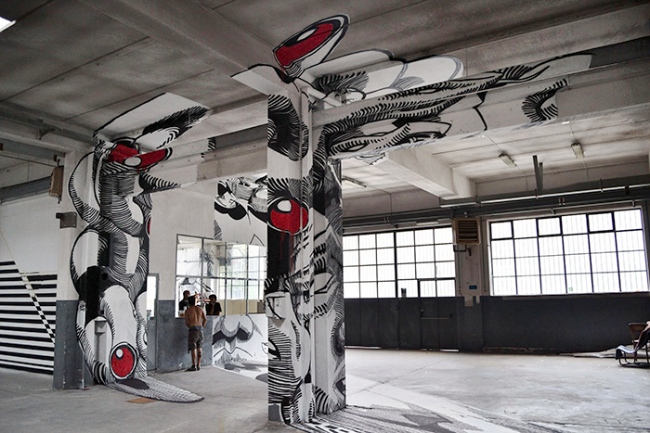
We have all seen these street artists colouring our pavements without could not put the finger on what the piece actually represent. It is because you are not looking at it at the right angle. We are talking here about anamorphic art which has recently flourished all over the world.
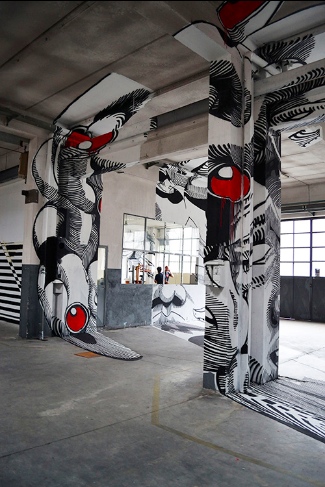
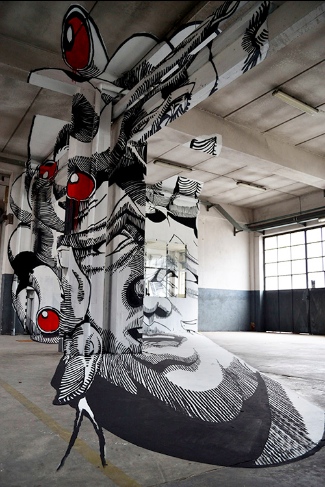
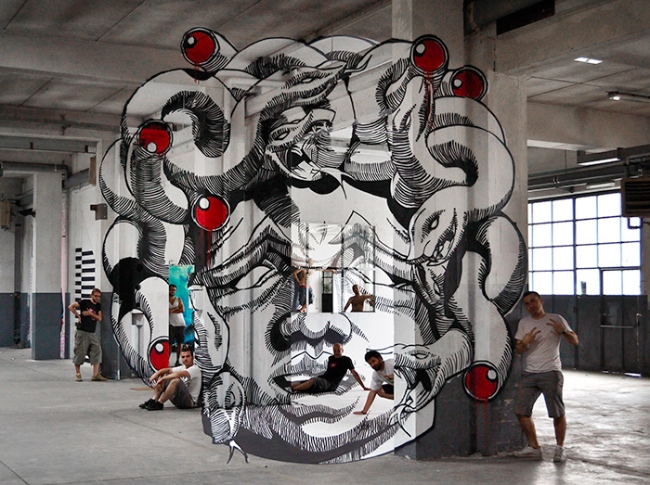
But some artists take this form of art to the next level making it methodical and magical. Located in the factory hosted by Sub Urb Art based in Torino (Italy), Medusa, figure from the Greek mythology, has taken the patience, attention to detail and talent of two artists, Ninja1 and Mach505.
The number of surfaces used is phenomenal and make the task daunting. It took 35 hours to paint the whole lot. It was achievable by projecting the outlines of an existing Medusa drawing on those surfaces and paint over them.
“Also, tracing a projection might seem simple, but at a distance of 20 meters the pixels are the size of your head, and hardly visible at all because of other lights, so you do need to check what you’re doing from the viewpoint every once in a while. “
Chicago, IL – Rotofugi, home to toys and art. One of the best venues for pop surrealism a mere mile and a half away from my current home. The charming, light-filled space greets visitors with cheery figures by Kidrobot, Frank Kozik, Tokidoki, and others. Additionally, they have apparel, plush toys, journals, and a variety of knickknacks. It’s easy to lose track of time, awed by all the clever and intricate crafts. The gallery, with constantly changing exhibits, is located towards the back of the space.
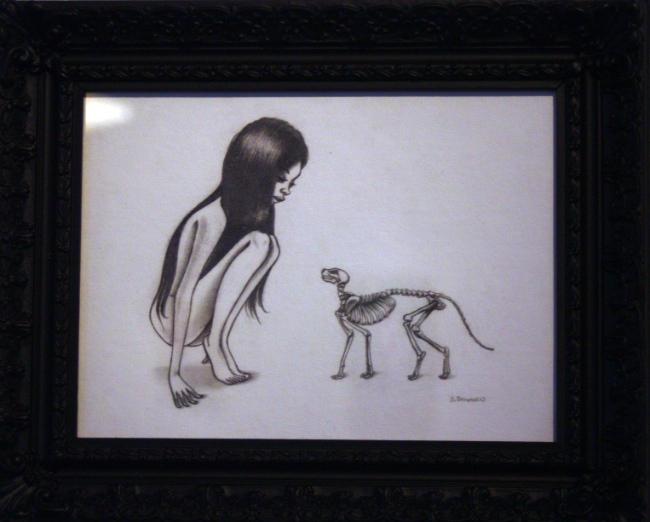
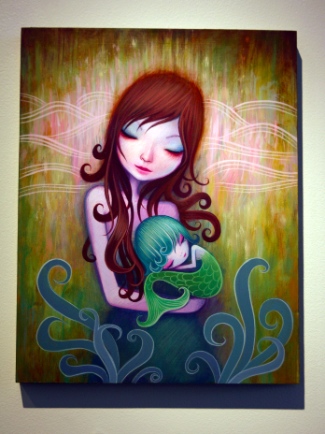
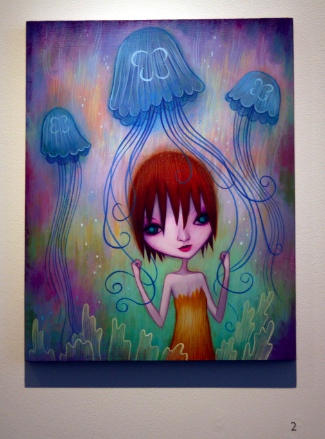
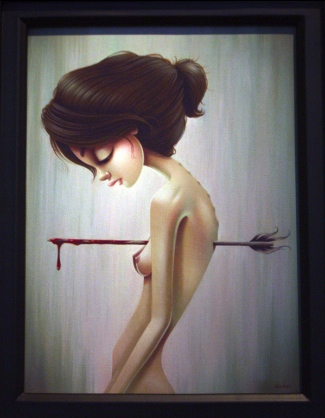
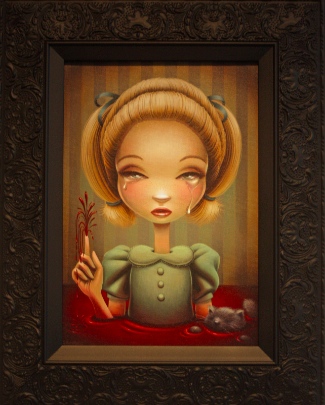
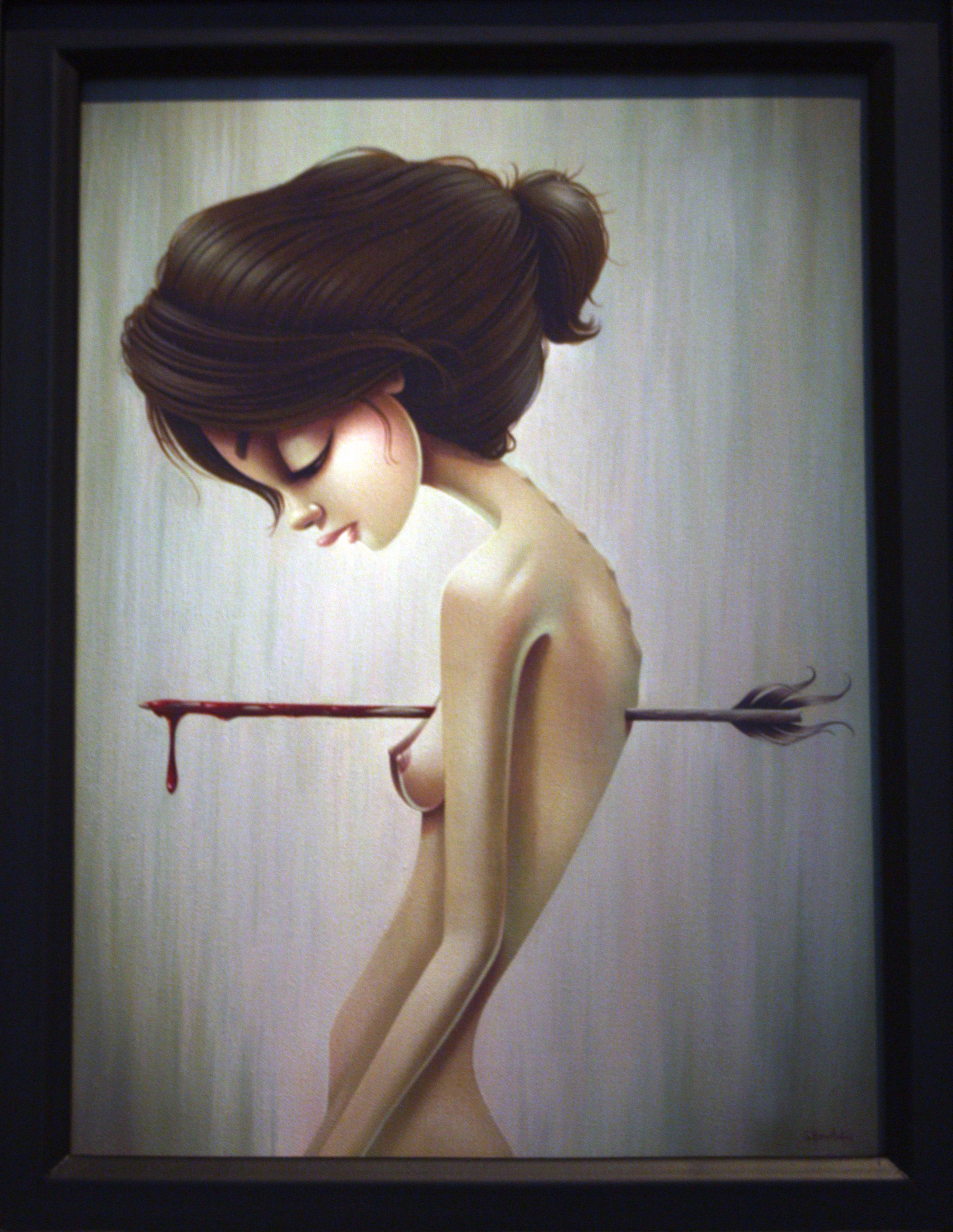
Two artists, Jeremiah Ketner and Shannon Bonatakis compose the most recent exhibit, on view through December 4, 2011. Both artists highlight femininity in their work in a style that incorporates soft brush strokes on medium sized canvases to create an ephemeral quality. However, their works diverge on all other areas.
Ketner paints whimsical images that transport you to a serene oceanic world. His cartoonish pixies follow the style of Japanese anime. Ketner says “everything is small and round” in Japan and his subjects reflect that notion. Bonatakis uses a similarly soft method of portraiture, focusing on young women. However, her characters are not hybrids of fantasy. The long sleek figures lack the sense of whimsy found in Ketner’s work. Bonatakis’ images instead, incorporate a sense of macabre. Although blood and severed body parts confront the viewer, they do not disrupt the scene. The characters have an uncanny acceptance of their fate and seem empowered by their imperfections or the fate bestowed on them. Resignation abounds as they penetrate the viewer with a lustful resonance. Eerily, these images instill the viewer with a sense of serenity.
This is Bonatakis’ first show at Rotofugi. She currently resides in Denver and is active in galleries across the US.
This is Ketner’s third show at Rotofugi. He has shown at over 50 galleries across North America. His characters grace the walls of Nordstroms throughout the country. Ketner also makes figures and plush toys. He lives in Chicago with his two sons, and together they explore the city.
Rotofugi Gallery is located at 2780 N. Lincoln Ave. Chicago, IL 606 They are open between 11 am and 7 pm, 7 days a week.
Once again I was on my way to the Elms Lesters Painting rooms to go and check out the latest dimensional paintings from Adam Neate. I still had so many good memories from Adam Neate’s last year’s show, also held at this venue, that I could not wait to see what this new show had to offer.
The layout and feel of the Elms Lesters painting rooms is as I remembered it – high ceilings, wooden floors and a relative darkness only interrupted by spots of lights giving the artist’s pieces all the shine and attention they deserve. But Adam Neate’s works would not even need all that for the visitor to quickly realise that what they are looking at is something quite special, something you also need to look at for a little moment to get what it actually is.
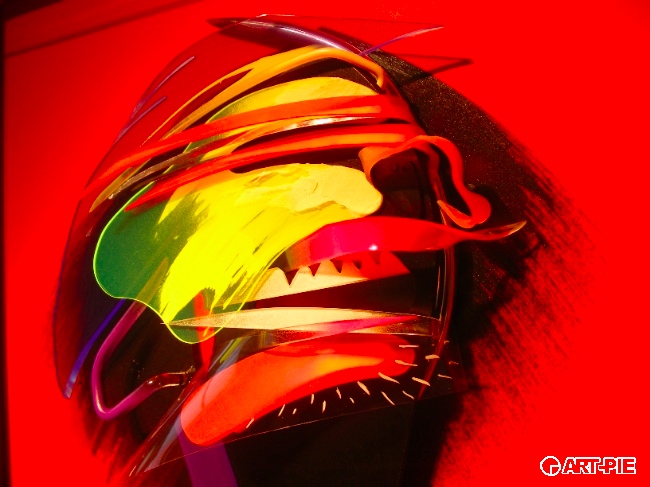
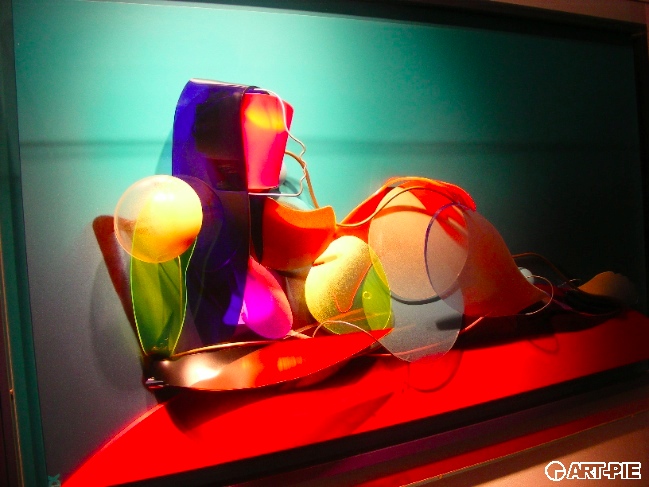
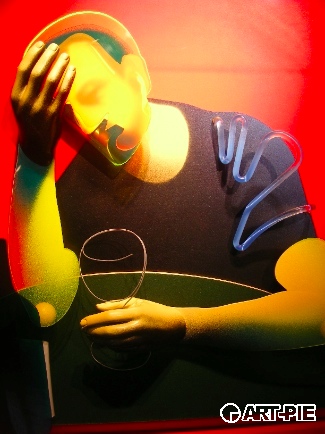
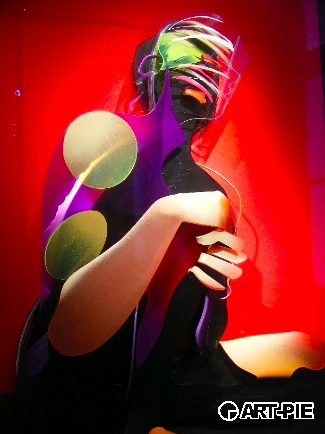
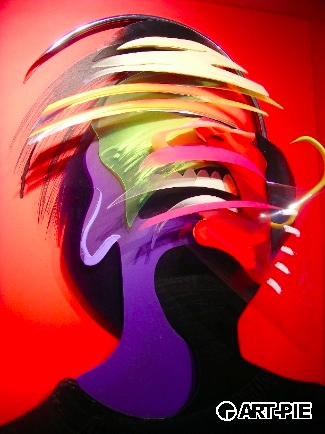
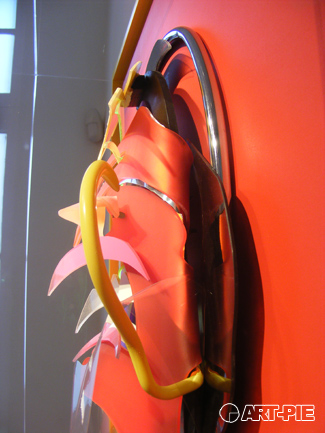
Acrylic, perspex, metal and aerosol on board : there you have what makes up Adam Neate’s works. But these mediums need some solid imagination as well as some advanced manual dexterity to transform and assemble some elaborate and intricate pieces of dimensional art – Adam Neate has just done that.
The palette used is flamboyant with a preference for red, the shapes are rounded, the end result is astonishing. Adam Neate’s art is very evocative, his job is to put shapes and colors together, your job is to see through these and come back out with a vision of the piece, your own vision of what you are actually looking at. I found his series of “Red Dimnesional Portraits” very powerful, I could almost hear them shouting at me as I walk past them. The flamboyant colors and defaced visages have certainly something to do with it.
Adam Neate
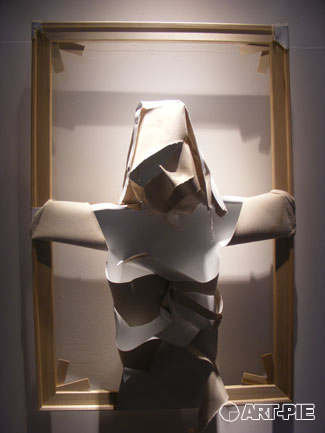
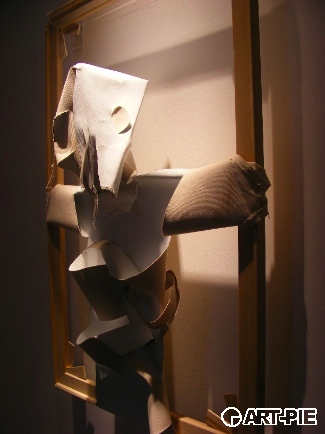
This review will not be complete without mentioning his “Canvas Crucifix”. The Elms Lesters Painting rooms have been accommodated to give even more emphasis to this amazing piece of art. A wall was especially made so the piece could be hang on and with a clever setting of light and shadow, isolate the piece from everything else and draw people’s attention. I found myself very intrigued, slightly apprehensive and thinking “What the hell is that? Adam Neate torn the whole canvas, while still attached the frame, in a such way that he managed to produce what looks like a character on a crucifix. No painting here just a very original use of the canvas as such – a dimensional approach again.
The show at Elms Lesters Painting Rooms is now over. You will find more pictures of the show by scrolling down.
Adam Neate – Blue Reclining NudeAdam Neate – Red Dimensional Portrait
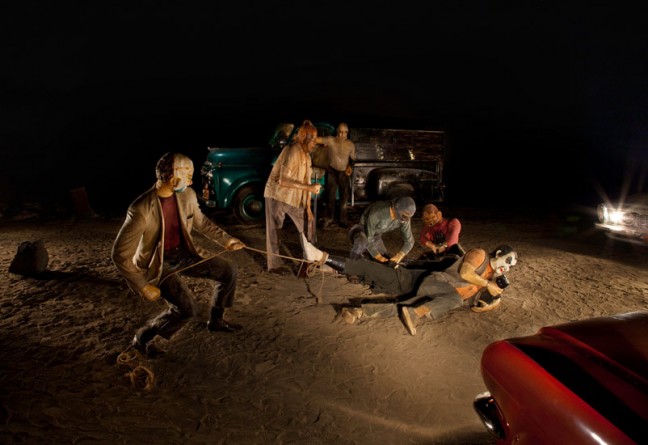
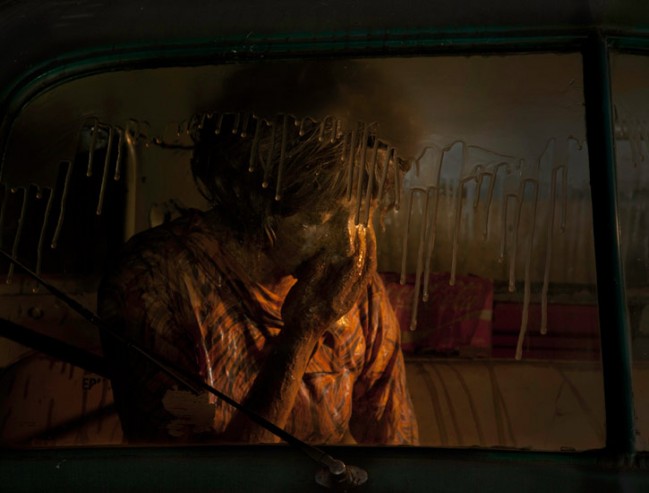
Edward Kienholz’s Five Car Stud depicts a horrific scene of racial violence during the civil rights era. Actually, the term horrific does nothing to illustrate the nauseating effects of this life-size interactive work currently on display at the Los Angeles Contemporary Museum of Art.
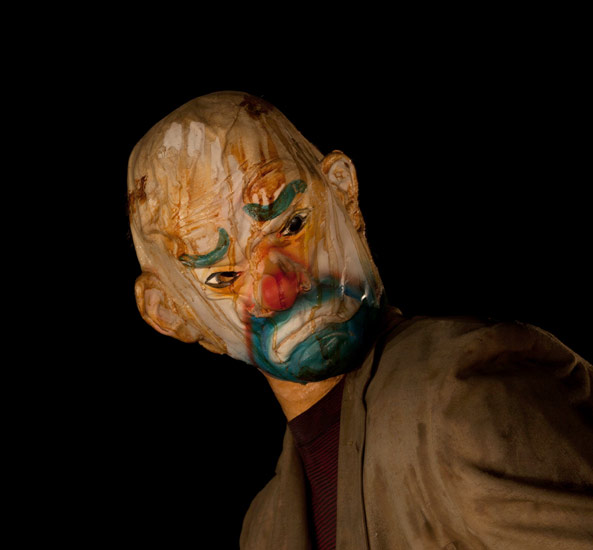
The piece is set up in a darkened room with a sandy dirt floor. Five cars form a circle, illuminating the focal point of the work with their headlights. Life-sized, white male figures stand next to their cars menacingly wielding batons and other weapons. One man holds a shotgun at his side. Clown-like masks and sagging skin cover their faces. The eyes are hollow and insipid, yet smirk at inflicting pain upon another human.
The sense of entitlement emanates not only from their facial expressions, but also from the positions of the bodies and the looming presence of each of these men. Garbed in jeans with the ruddy faces of moonshine alcoholics, they abuse and castrate another man, lassoing his foot like cattle, simply due to the color of his skin.
The victim lies in the center of the scene flanked by two men gripping his arms. Instead of casting an entire figure, Kienholz installs a rectangular trough in place of his torso. He filled the trough with water and six wooden alphabet blocks, two of the same letter, floating around, and leaving the viewer to piece together their meaning.
Kienholz spent three years working on this project between 1969 and 1972 during the height of civil rights era when activists had reached some victories for desegregation. However, through his depiction viewers realize that prejudice and unfounded bias continue to infiltrate society.
Kienholz is best known for using found objects to create jarring sculptures that comment on social issues within the United States. He created this work shortly before he relocated to Germany where it first appeared publicly. A private collector acquired the work and for 40 years it remained in storage. Los Angeles County Museum of Art is the first to display the work in the United States.
I do not exaggerate the gravity of this work. Guards stand at the doorway advising parents against allowing their children to witness it.
The pictures cannot convey the deeply unsettling feeling evoked by the piece. Perhaps it is the blatant intolerance, the flagrant violence, or simply the knowledge that things have not changed enough. Whatever the reason, whatever the effects, Kienholz has created a penetrating work that shocks viewers with its content but awes with the undeniable skill and ingenuity it took to mastermind.
The sudden death of Richard Hamilton yesterday shocked a large number of people in the art world, tweets poured in and everybody agrees – it is a big loss. Some critics are convinced that he was the most influential and important painter post-war, others would defend the fact that he was the root of Pop Art.
Whatever he was, and even if he got expelled from the Royal Academy Schools in his early years on the grounds of “not profiting from the instruction”, Mr Hamilton made his mark in the dense art world and will be remembered for decades if not forever. Here is a tribute to him, here are some of his most iconic works.
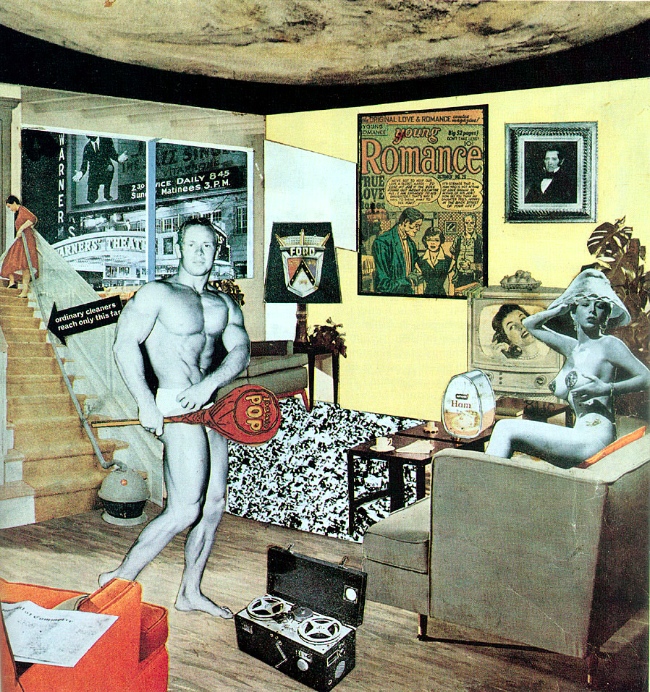
Hamilton was known for his paintings, sculptures and collages. Collage is what we will be looking at first and in particular his piece entitled Just What Is It That Makes Today’s Homes So Different, So Appealing?, made in 1956 and regarded as the first statement of Pop Art.
A bodybuilder holding a lolly with the word pop on it makes the focus of this piece. This work was part of the This Is Tomorrow show held at the Whitechapel Gallery. A great artist was on route and he was going flat out.
Just What Is It That Makes Today's Homes So Different, So Appealing? by Hamilton
Richard Hamilton then went on getting various assignments where political views were expressed but more importantly he met Marcel Duchamp, became friend and curated the first and to date only British retrospective of Duchamp’s work that was held at The Tate in 1966.
White Album He produced at the same period a series of prints, one of them being Swingeing London inspired from the arrest of Fraser’s and Mick Jagger, for possession of drugs. He then carried on on the pop music scene subject and produced the cover design and poster collage for the Beatles’ White Album
Here is what the artists had to say about this cover: “I thought it would be appropriate to present an album that was just white. Paul was doubtful about it being completely empty so I suggested that it would be fun to number each copy so that it would have the appearance of being a limited edition. I asked how many copies the band expected to sell, and they said about eight million. I made a quick calculation that we would need seven digits.”
After meeting a series of pop artists in America in the late sixties, he moved back to his native country, the UK and in particular in Oxfordshire where he produced a series of paintings and installations where artwork and product design mixed. This period was very fruitful but has always been disregarded and undermined by the series of works he will put out there in the eighties where the focus point was the conflicts in Northern Ireland – another example of Richard Hamilton’s recurrent interest for what was going on around him during his time.
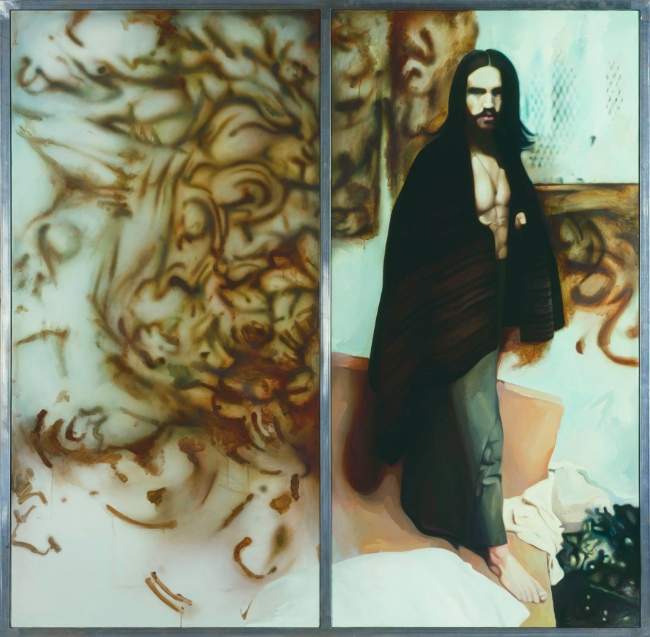
One of the major piece of this period was The citizen part of a trilogy of paintings (1981-83) shows IRA prisoner Bobby Sands portrayed as Jesus, with long flowing hair and a beard. Republican prisoners had refused to wear prison uniforms, claiming that they were political prisoners. Prison officers refused to let “the blanket protesters” use the toilets unless they wore prison uniforms. The republican prisoners refused, and instead smeared the excrement on the wall of their cells. Hamilton explained (in the catalogue to his Tate Gallery exhibition, 1992), that he saw the image of “the blanket man as a public relations contrivance of enormous efficacy.
The Citizen by Hamilton
The best way to wrap up this tribute is probably to let Richard Hamilton gives us his definition of Pop Art: “popular, transient, expendable, low-cost, mass-produced, young, witty, sexy, gimmicky, glamorous, and Big Business” – stressing its everyday, commonplace values.”
Richard Hamilton was working on a major museum retrospective, let’s just hope it can be carried over and happen anyway.
R.I.P Mr Richard Hamilton (1922 – 2011) Richard Hamilton

 Chicago, IL – Rotofugi, home to toys and art. One of the best venues for pop surrealism a mere mile and a half away from my current home. The charming, light-filled space greets visitors with cheery figures by Kidrobot, Frank Kozik, Tokidoki, and others. Additionally, they have apparel, plush toys, journals, and a variety of knickknacks. It’s easy to lose track of time, awed by all the clever and intricate crafts. The gallery, with constantly changing exhibits, is located towards the back of the space.