

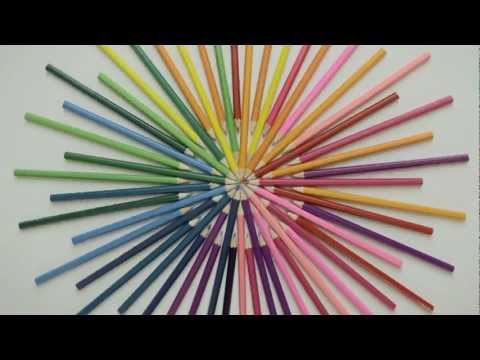
Dropbear's latest stop-motion
920 pencils and 5125 images is what what Jonathan Chong (also called Dropbear) needed to put together this very neat stop-motion for the Melbourne-based indie-folk band called Hudson. Enjoy it below.
Also included is a “behind the scenes” footage just to tell you how much work this sort of work involves, loads, no really a tremendous amount of time and patience!
<iframe width=”649″ height=”330″ src=”http://www.youtube.com/embed/TuBMXS6vU3o?rel=0″ frameborder=”0″ allowfullscreen></iframe>
<iframe width=”649″ height=”330″ src=”http://www.youtube.com/embed/-D8aXtHS42g?rel=0″ frameborder=”0″ allowfullscreen></iframe>
Leonardo Da Vinci: Painter at the Court of Milan
 The much hyped Leonardo Da Vinci exhibition opens at the National Gallery from today with a seven room exhibition. The display is ideal for those who adore the technicality of the line and the workings of an artist , with many drawings and paintings by Leonardo and his pupils on display.
Its build up has been felt for many months, ever since its advance booking opened in May 2011 – a long seven months before its actual opening day.
With its future opening date released then came the capped visitor numbers announcement, with the gallery saying it would restrict visitors due to an, ‘unprecedented demand’. Today (9 November) The Evening Standard has reported how the tickets have sold out until mid-December. The pressure for this display to deliver to its global audience is immense.
The exhibition brings together an impressive collection of international loans never before seen in the UK, from the Queen, America, Poland, France, Scotland and from Art Fund acquisitions.
One difference with this exhibition from others is it the first to be dedicated to Leonardo’s aims and techniques as a painter. Don’t expect reams of glorious huge paintings, though there are a few pretty ladies, curly haired men and angels.
The whole display focuses on Leonardo as an artist, his technical skills and his teaching skills, showing how his works were often finished or copied by his pupils, and in some cases edited. In particular it concentrates on the work he produced as court painter to Duke Lodovico Sforza, in Milan in the late 1480s and 1490s.
As well as finished pieces, each room is peppered with Leonardo’s preparatory and experimental sketches.
The final part of the exhibition, a few mintues walk away in the Sunley Room features a near-contemporary, full-scale copy of Leonardo’s famous ‘Last Supper’, on loan from the Royal Academy. Seen alongside all the surviving preparatory drawings made by Leonardo for the ‘Last Supper’ it makes for an interesting viewing, but seems rather ‘tagged’ on to the exhibition.
Pieces to stop by:
The Musician (1486-7) Room 1 – An unfinished portrait demonstrating Leonardo’s skill in positioning of the face creating a life like portrait with depth.
Portrait of Bianca Maria Sforza (1493) Room 2 – Get your fill of opulence with this lavish picture showing a traditional Milanese style dress, with Leonardo’s profile technique on full view.

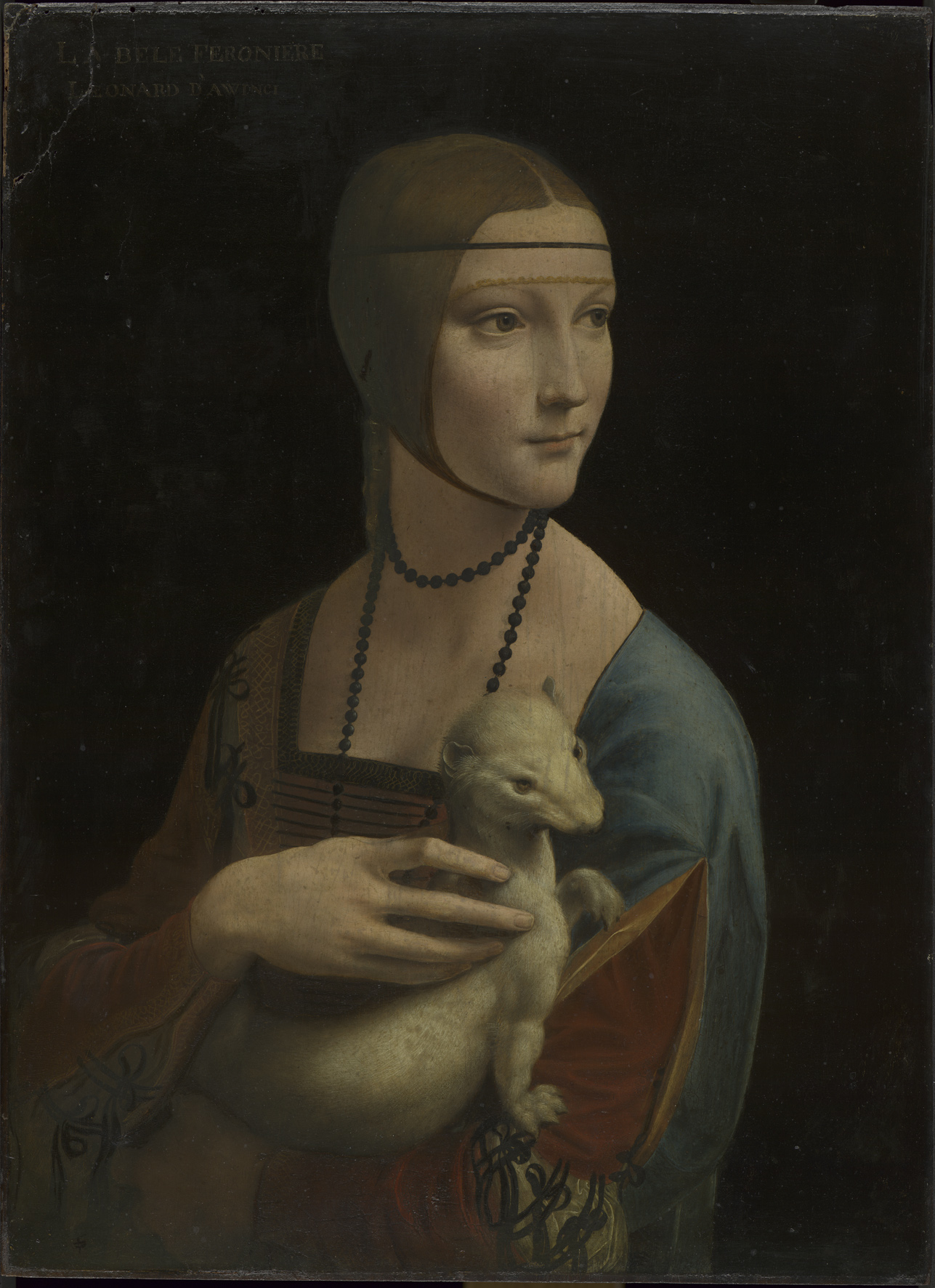
The Lady with an Ermine (1498-90) Room 2 – This piece is centre stage of the room and shows off Leonardo’s portraiture and colour skills. The lady almost leaps out of the canvas due to her 3/4 turned pose and the black back background, giving her a 3D quality that soon become sort after by Leonardo’s pupils.
Studies of the Nervous System (1485-8) and Studies of the Human Skull (1489) Room 3 – This is one of many anatomical studies in this room, and they took my breath away. He’s used hints of shadow and light to depict tiny features of the human body. The skull looks perfect in minature form and these observations were no doubt the ground work for his future paintings, making figures seem as real as possible. It astounds me how these delicate sketches are over 500 years old.
The Virgin of the Rocks (1493) Louvre and Virgin of the Rocks (1491/2-9 and 1506-9) National Gallery Room 4 – These pieces are obviously the focal point for this room and essentially a key point for the exhibition. They are on show together for the first time and are intended to show Leonardo’s difference in style and views of painting and art. The earlier piece is very rich in colour and could easily fit into a church altar piece. The second is restrictive in its colour palette and the figures are more sculptural with a porcelain quality.
The Burlington Cartoon ( 1499-1500) Room 6 – This lively large piece in charcoal seems to move as you move around it. The unfinished aspect of the piece almost makes it work more, it stands out in this room. The figures are fluid and contemporary, it’s a break away and step up from Leonardo’s meticulous anatomical studies.

Room 7 in the Sunley room has a handy time line of Leonardo’s artistic career, with significant events and works. This would of been suited to have at the beginning of the exhibition, putting this display into context even more, especially for those less familiar with his pieces. The room feels tagged on, an afterthought. It’s interesting to see the workings that may have gone into this work, and then the copy of the Last Supper is astonishing to see in its grand scale.
Head along to this exhibition for a peek into Leonardo Da Vinci’s undoubted skill as a technical drawer and creater of astonishing life like works, which capture humanity and idealised beauty in all its forms. He perhaps saw himself as a creator and observer of humanity, what’s key from the exhibition is that he was always striving for improving his skills and thankfully we get to see these still today in this exhibition.
‘If the painter wishes to see beauties that enamour him, he is the master of their production, and if he wishes to see monsterous things.. he is their lord and god.’
The exhibition is open now: 09 Nov 2011 – 05 Feb 2012 Mon – Thu, Sat, Sun 10:00 AM – 6:00 PM; Fri 10:00 AM – 9:00 PM Closed Christmas Eve, Boxing Day, Christmas Day.
Pimpartworks.com – new prints section

You must check out PIMPARTWORKS if what you are after is awesome and truly unique urban and street art and much more. Read below a few words from Steve at Pimpartworks and check out some of the art included in their new Limited Edition, Signed and Numbered prints section. Continue reading Pimpartworks.com – new prints section
Word To Mother at Stolen Space
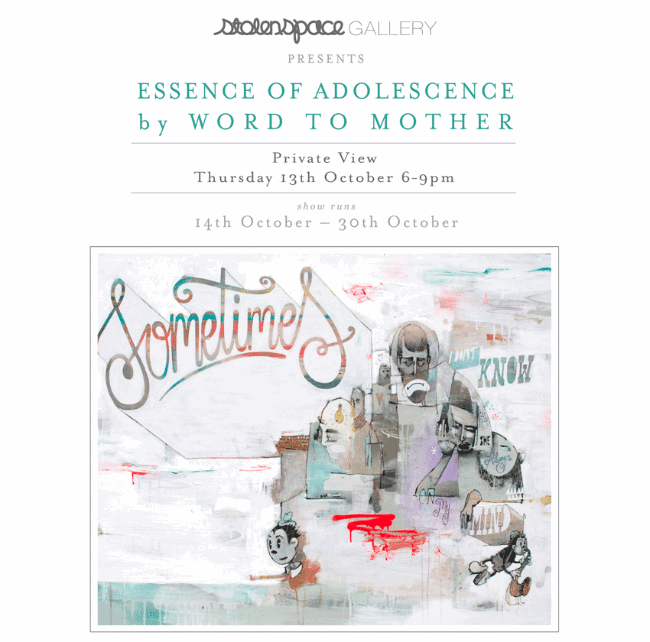
StolenSpace is proud to present Word To Mother’s fifth solo show with us, entitled ‘Essence Of Adolescence’ featuring a new body of mixed media paintings on wooden panels.
‘Essence of Adolescence’ is an enlightening glimpse into the artist’s visually obsessed mind. Word To Mother invites the viewer to take a glimpse of his inner mindscape. An outward manifestation that combines references drawn from his childhood and the visual stimulation that he absorbed; cartoons juxtaposed with more serious emotive thoughts and fears that face him as an adult living and painting in East London.
Incorporating hand drawn personal sentiments,emotions and feelings that he executes in the form ofloose script, inspired from his experience as a tattoo artist and tight sign written letters, drawn from years of painting graffiti. A beautiful juxtaposition, of fragile and emotive elements shown through subtle textures and washes of colour, but with a strength and confidence fused with his signature patterns, architecture & figures, this body of work is melancholic yet fun and playful.
With anearthy ‘London’ palette of grey tones excentuating splashes of brighter ‘seaside’ colours of fluro red, pink, yellows and turquoise which give the paintings an optimistic feel. Word To Mother draws inspiration from an adolscence which holds precious memories, juxtaposed with an adulthood which has made him the talented artist he is today.
Word To Mother
‘Essence Of Adolescence’
14.10.11 – 30.10.11

Tim Noble & Sue Webster shadow sculptures
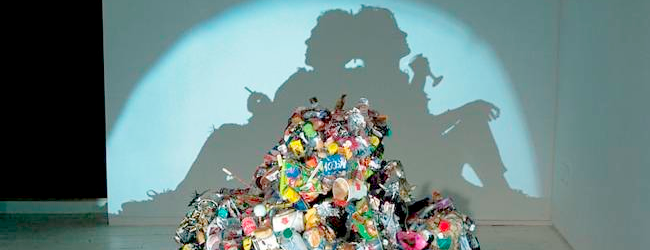
One day Tim Noble met Sue Webster, the year was 1986 and the context was that they were both studying Fine Art at Nottingham Trent University. The next we know is that they have Tim Noble and Sue Webster for over seventeen years.
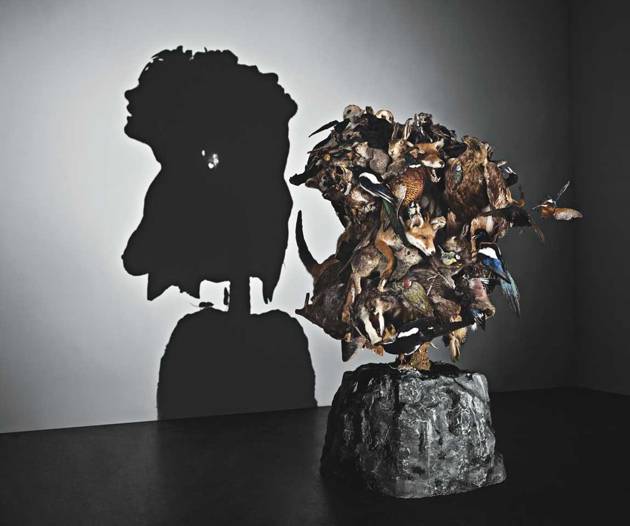
What do they create? Sculptural artworks made from discarded wood, welded scrap metal, broken tools, cigarette packets, soda cans and piles of trash. If you look at the pile of objects they assembled and piled, you see nothing but the light they point at it makes the magic happen – you find yourself in front of projected shadows projected shadows of people standing, sitting, smoking or drinking for example.
You’ll have understood that the precision and patience are out of this world. Every debris must be carefully placed, distances measured and spotlight angles revised again and again.
YOUNGMAN, 2012
1 wooden stepladder, and discarded wood
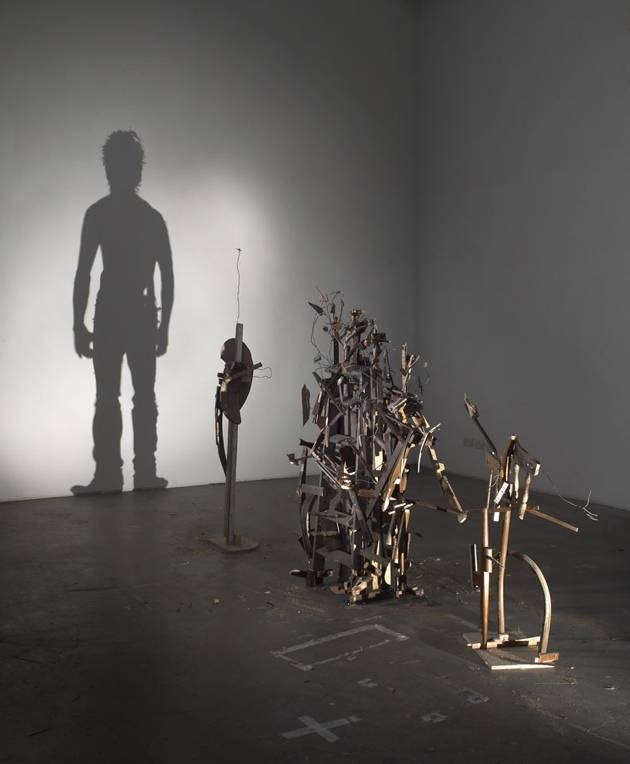
But beyond the piling exercise, the creative output is remarkable and powerful and question the notion of abstract forms being able to turn themselves into figurative ones
If you want to read more about what concepts lie behind these works, read this excellent piece from the Blain Southern gallery
We included 4 examples of these shadow sculptures as well as video telling you more about the concept
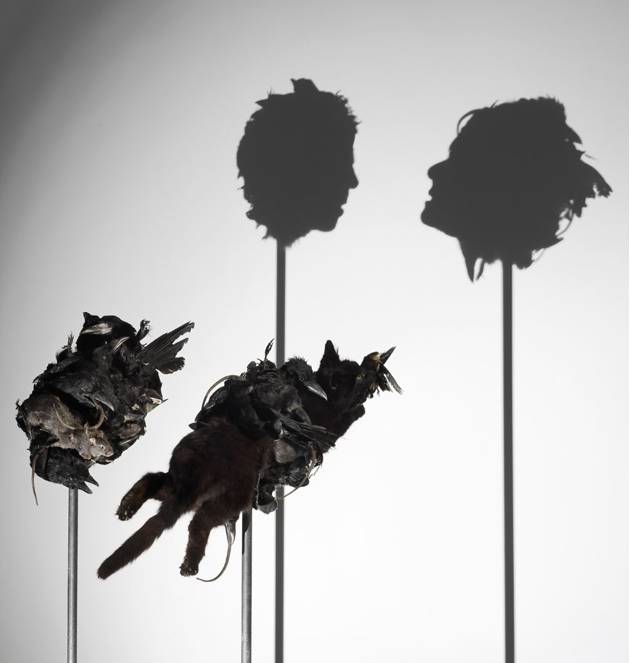
DEAD THINGS, 2010
1 black cat, 19 crow heads, 4 rook heads, 5 jackdaw heads, 13 crow legs/feet, a pair of crow wings, a pair of jackdaw wings, 6 juvenile black rats, 1 x chaffinch (male), metal stand
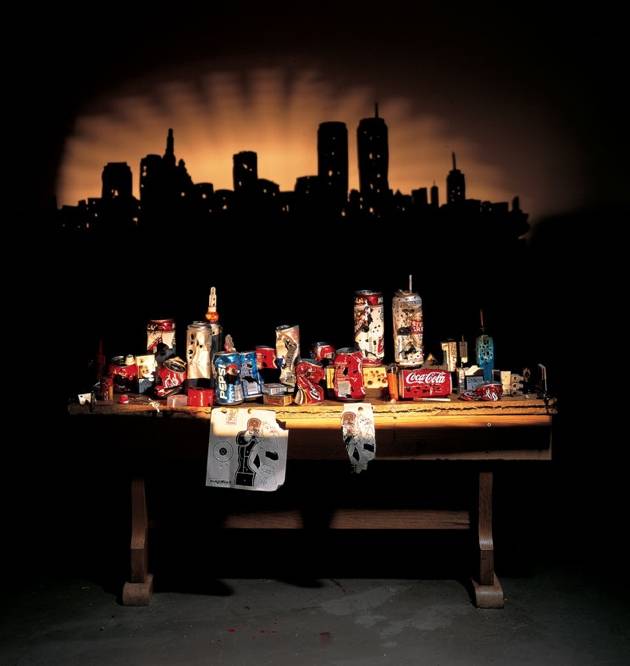
SUNSET OVER MANHATTAN, 2003
Cigarette packets, tin cans shot by air gun pellets, wooden bench
BRITISH WILDLIFE, 2000
88 taxidermy animals; 46 birds (35 varieties), 40 mammals (18 varieties), 2 fish, wood, polyester glass fibre filler, fake moss, wire
First seen on Marvellous
#4 Group show at The Rag Factory
Tutorial: how to paint mountains with oil paint

Learn how to paint mountains with oil paint Continue reading Tutorial: how to paint mountains with oil paint
Born in the streets – New York city legends

I do not go to Paris very often – fact. Quality not quantity they say, well it was definitely quality this time.
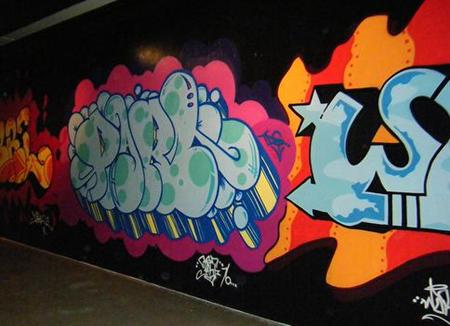
‘Born in the streets’exhibition was one of a those events not to miss if you like street art and especially graffiti. Continue reading Born in the streets – New York city legends
Wimbledon Art Studios
Want to see art outside of the commercial galleries? Or maybe like me you have lofty dreams of starting your own art collection. This weekend take a trip to South West London from 25 November to the Wimbledon Art Studios, Winter Open Studios Art Show. The open show sees artists opening up their studio spaces this weekend, giving the public the chance to explore a treasure trove of new works. There’s an eclectic mix by up and coming, as well as established artists, photographers, ceramicists and textile designers.
Community and the artist

The Wimbledon Studios aim to provide a spring board for working artists, which couldn’t be apt in today’s dire financial climate. The studios are the largest, single site art studio complex in London and Britain. This fantastic project is not merely about the singular artist and the creative community within, Wimbledon Art Studios aim to give local people the opportunity to view and appreciate contemporary art, whilst building links with the resident artists.
The opening night was bustling with proud parents, artist’s friends and locals. The last open show attracted over 5,000 visitors and I suspect they shall hit they figure or more this year.
On the preview night studio workers were happy to talk about the spaces and I was impressed by the colour map brochure produced for the show. Plenty of friendly guides and artists were on hand when I lost my bearings in the rabbit warren of corridors and stairways, so be warned you may loose yourself but find an interesting artwork in the process!
The entrance, which bridged the two buildings in a temporary structure, displayed some key pieces including Kate Kelleher’s eye catching painting, and a sculpture by Kevin Herlihy who uses found and recycled mediums. There were also some small board works for sale to raise money for the studios upkeep. At £55 a go, I decided to snap up a board by Jayson Lilley. Other artists you should stop by at – Darryn Eggleton‘s amazing animal paintings and Alison Pearl‘s delicate and seemingly impossible objects made from paper.
Inside the spaces
As I tottered around with my new art work I explored the studios which are spread over 2 areas. The main Red Studio building, originally a paper warehouse, opened with just 6 artists renting spaces in 1993. Now, the original warehouse consists of over 100 studio spaces and in addition there are now 60 studio spaces in a newly, purpose built ‘Blue Studios’ building, on the same site. On 1st November 2011 an additional 55 brand new studios were opened in a reclaimed section of the warehouse. Now the site has over 200 artist tenants. The close proximity of the studios make it feel homely, it felt like I was stepping into a person’s private space, almost like their bedroom, a definite plus side away from the clinical commercial gallery spaces.
The artist and the studio
Is a studio site like the one in Wimbledon an ideal place for an artist to gain recognition though? And do the resident artists actually like the makeshift space in the built up industrial estate in Wandsworth? I asked Idun Eustace, an resident artist at the Wimbledon site who is displaying her pieces for the show.
Idun has been at the studios since 2007 and first exhibited during the autumn show. Idun lectures in life drawing and oil painting for EAL, Ealing, West London. Her works of semi-abstract still life evoke many influences from the Norwegian landscape where she was born and brought up.

What do you think of the new studio space that opened in November 2011? So how does it compare to other, more formal, settings you’ve shown at? Such as gallery spaces/fairs?
The new space (as a whole) has got a nice feel to it & is much more spacious than the studios in the old Red Studio building – Although my new space has no natural light ,I feel this doesn’t matter so much, as I look upon it as a challenge to see how it changes my work. There are studios with natural light but I chose this one for the space as I want to run life drawing classes from there as well as paint.
Do you feel the studios are successful in terms of building a creative hub for emerging artists and also for artists to sell their work too? Or do the more traditional roots of art fairs and private galleries, like the Affordable Art Fair, work better?
I think it’s a little hit and miss sales wise – sometimes you sell and others not. The good thing about the studios is that they don’t take a commission on sales whereas fairs, such as AAF and other London Galleries take 50 %. It does give merging artists as well as more established artists a great platform to sell their work.
Where do get your ideas for pieces? Whilst travelling around London, or more abstractly?
I draw a lot and source ideas almost everywhere – e.g. If I go in to London on the train (with my sketchbook) I will look out of the window and take a mental picture and draw it immediately, or when I’m on holiday (usually to Norway), I always have my sketchbook (and camera) handy. I also sometimes draw and paint from memory so these may be more abstract – I look on the drawing process this way; if you’re an artist you ought to draw as its part of the process of painting. Painting is really drawing with your brush.

You are trained in many different disciplines, painting, printmaking, life drawing, photography, graphics, illustration & textiles. Do you or would you ever incorporate these into you pieces?
I do use photography as reference only, whether it be a design ref or a colour reference – I have used printmaking in my art but not currently – I do however like the way Munch used print making as reference/addition in his art and have recently been looking into this. I’m quite interested in African tribal art textiles. I have also been toying with the idea of introducing burlap/hessian in my work but at present this is embryonic only. I am looking at the work of artists like Tapies and Sandra Blow for inspiration.
You are quite active on Twitter, do you feel artists have to embrace this more so now? Have you felt the need to use it more?
I feel the use of twitter is essential to reach out to a wider audience and think that one’s got to advertise oneself, no-one else will do it for you and hopefully one’s twitter followers will RT and thus reach more people – so it can only be a good thing. You have to grab opportunities as life is too short.
Idun’s works feature at the open show till 27 November and she is also planning to run classes that will be available to artists at the Studios as well as outsiders, contact her here for more information idun@blueyonder.co.uk. Follow her on Twitter @idunart
The Open Studios Art Show at the Wimbledon Art Studios is open to the public till 27 November Friday 2pm – 10pm
Saturday & Sunday 11am – 6pm. For more information about the show and the artists see click here.