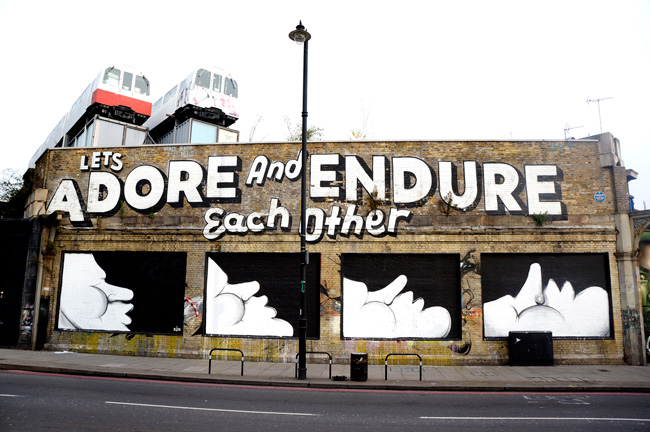
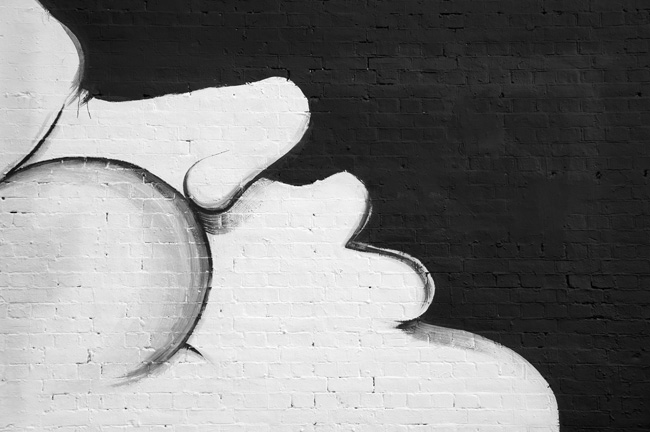
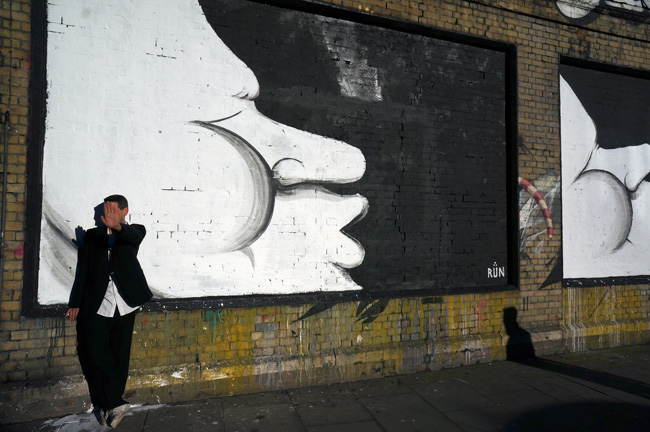
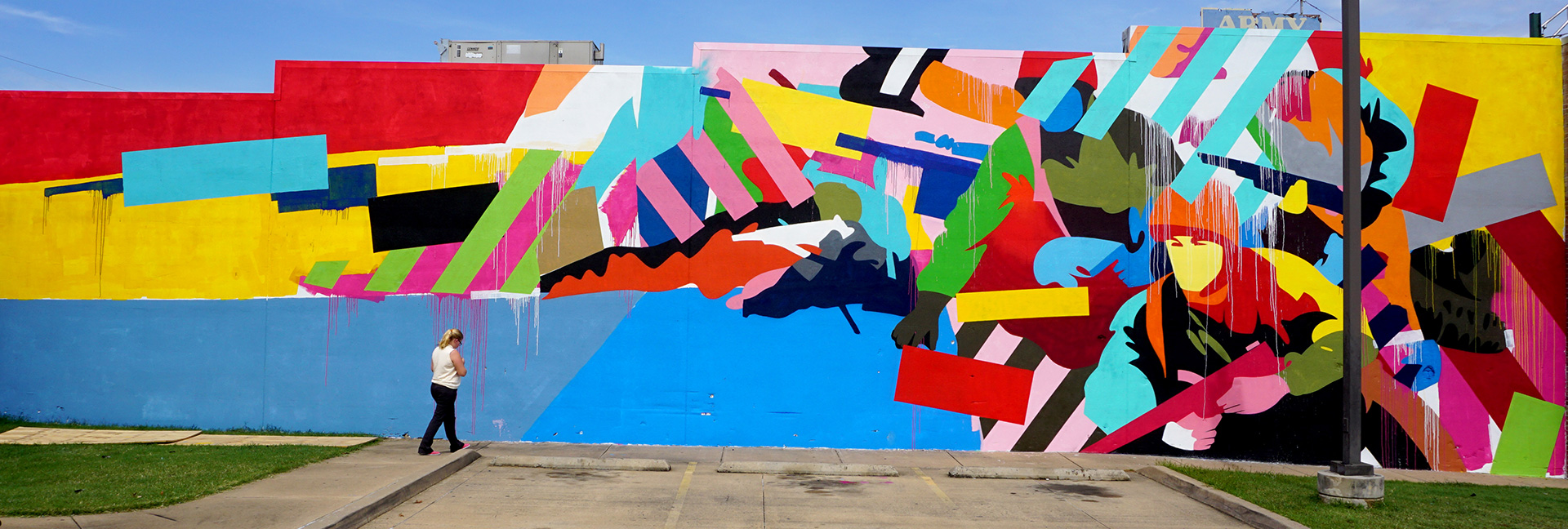
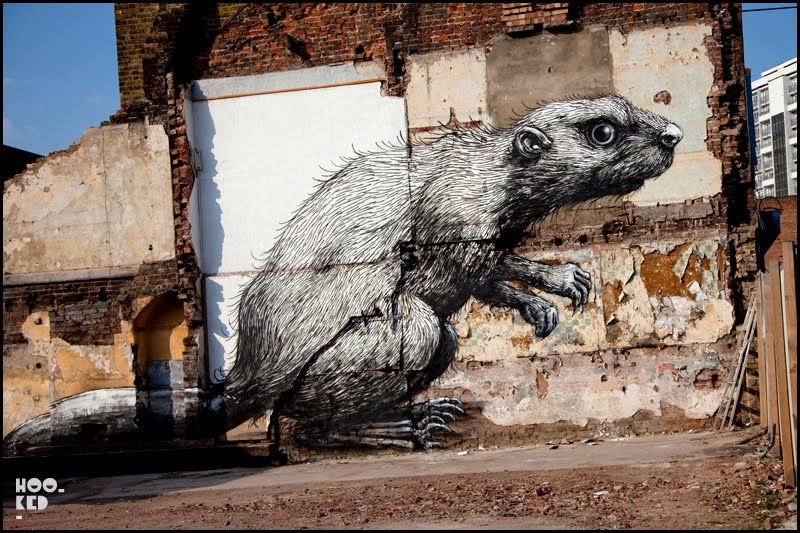
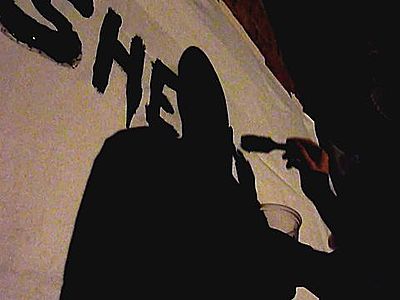
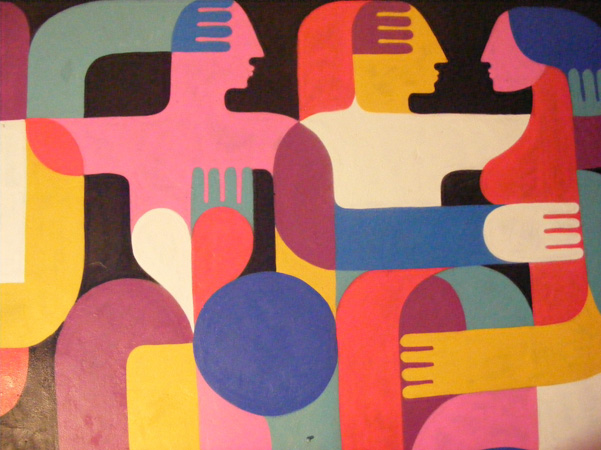
Artist RUN just finished his piece on the walls of the Village Underground project space and has kindly sent in a few pictures which are shown below. This commission came as a bit of a surprise for the artist since the guys at VU rang him at the last minute and asked him whether he would like to fill the 6 days off advertising gap by painting the outside walls
The job took about 5 hours and depicts one of classic RUN’s feaure already seen across London streets and beyond.
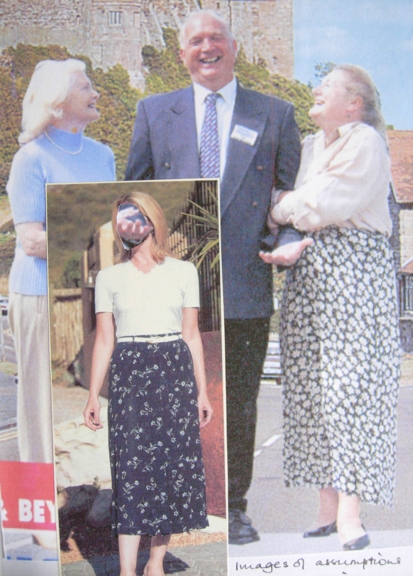
Sarah Hervey has a note in her sketchbook, it reads, “Wittgenstein maintained every statement rested on unproven assumptions and illogical associations”.
With regard to language there are four problems outlined by Bertrand Russell in his 1922 introduction to Wittgenstein’s Tractatus Logico-Philosophicus:[1]
First is a problem of what actually occurs in our minds when we intend to mean something.
Second is the relationship between thoughts, words and sentences and what they refer to.
Third is a problem of constructing sentences to convey truth rather than falsehood – in a logical sense rather than in a factual sense of true and false.
Fourth, what relation must a fact have to another in order to be capable of being a symbol for it.
According to Russell’s essay, the fourth problem is what concerned Wittgenstein and it is at the heart of Sarah’s note to herself, which is positioned in relation to this image in her journal:
Images of Assumptions, (c) Sarah Hervey, sketchbook collage
“In the language of everyday life it very often happens that the same word signifies in two different ways – and therefore belongs to two different symbols – or that two words, which signify in different ways, are apparently applied in the same way in a proposition [a statement]…[t]hus there easily arise the most fundamental confusions.”[2]
Ludwig Wittgenstein
The problem of clear communication is further complicated by psychology, the first of Russell’s four problems with language, and identity, the second. What does it mean to be vulnerable? We all know what it feels like and so we feel we can describe and understand it. But can we? David Minton a fellow exhibiting This ‘Me’ of Mine artist, asks Sarah if she thinks his male vulnerability is an attribute of feminine vulnerability, wondering “if the view of ‘masculine’ is dependent on the view of vulnerable as ‘feminine’?” It’s a compelling question.
Jane Boyer: Much of the vulnerability you are interested in and you explore is based in gender issues and ageing. Can you tell us what it is particularly about vulnerability, experienced through gender and age, which interests you?
Sarah Hervey: I think there has been a lot of research into why women live longer on the whole and have a resilience somehow, yet the way we are supposed to attract men is to be vulnerable, the weaker sex, so there’s all that dynamic which is interesting. Because I have this idea about skin and how your history shows on your face, so if you’ve had a life where you’ve felt vulnerable it will begin to show. As your body gets older you just appear more vulnerable because your skin gets thinner, your bones aren’t as strong, you find it more difficult to hold your head up straight and keep your back straight and so your body starts to cow. The different way men and women deal with that interests me; how we feel about that is the internal part of skin, then the way society looks at you is the external part. I mean, the essence of being female or male is different and I feel it is important to struggle to understand more precisely the positions of men and women within these boundaries. My point of view is as a woman. I can’t understand my own vulnerability and the vulnerability of women without understanding the vulnerability of men.
Read more of our interview, Without Any Voice. If you are enjoying reading about the issues involved with This ‘Me’ of Mine, follow the blog by clicking the ‘follow’ button under the heading Follow blog via Email at the bottom of each page and engage with us by leaving a comment, follow us on twitter @thismeofmine or like our facebook page, facebook/ThisMeofMine.
This is the contentThis is the contentThis is the contentrnrnThis is the contentThis is the contentThis is the contentThis is the contentvrnrnThis is the contentThis is the contentrnrnrnrn
This is the contentThis is the contentThis is the contentThis is the contentThis is the contentThis is the contentrnrnThis is the contentThis is the contentrnrnThis is the contentrnrnThis is the contentvrnrnThis isrnrnthe contentThis is the contentThis is the contentvThis is the contentThis is the contentv
At first, I misread what Dunn, aka Dan Ericson was all about. I indeed confused “signtologist” with “scientologist” and was about to move on when painted road signs caught my eyes and made me read twice. “Signtologist” it was. Not surprising to get mixed up here, who has ever heard of this term?
Roots MC, Black Thought would have apparently dubbed him back in 2005, the Signtologist, which Dan Ericson would eventually keep as its “artist” name. But what does it mean?
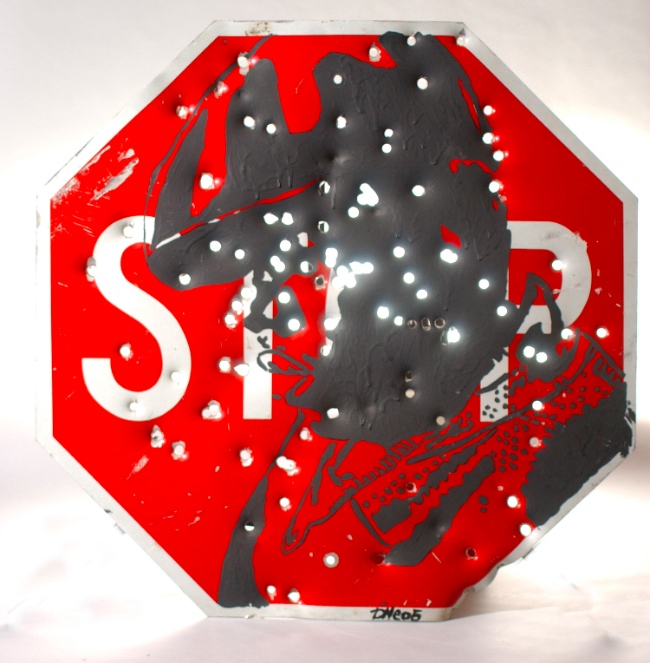
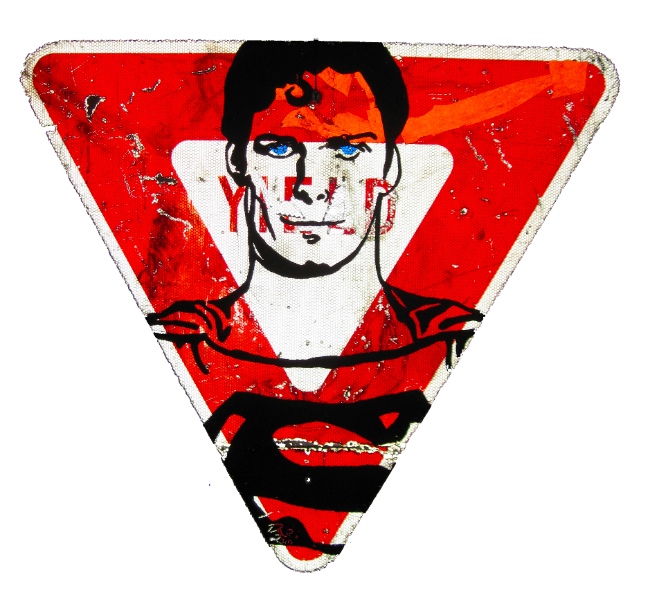
You may have guessed by now that it has to do with signs, and especially roads signs that he recycles into unique homages to the musicians, actors, public figures and athletes that inspire him.
Examples of this original art (photos: Terrence Duncan) are shown below. See more on the Signtologist website
We have come across this meaningful street art installation by Promesto and we like it so we talked to the artist and asked him to tell us a bit more about it.
Make sure to check out the video!
ART-PIE: What is “Alive Heart” all about? Promesto: This installation is built to provoke and catch the reaction of the people as they pass by the broken-hearted mannequin and to intervene in the daily life of broken hearts and reminds them: no matter how broken your heart is now – tomorrow is another day!
A-P: How are people reacting to it? P: People responded variously ‘heartbreak’ as a feeling of heaviness, emptiness, grief, sadness, confusion and even jealousy all at once. Our installation art on London’s famous Brick Lane made quite a few people ponder.
Some of the best quotes we got: “it’s a bit “scary-tragic but true”
“My heart was broken once. It really hurt and I’m glad it’s over.”
“I still remember that B!$%H or BA%$!RD”
On my way again to Pure Evil gallery. This time I was there to see Remed and I felt particularly excited about this one as the artist was born right from where I am myself from – Lille (France).
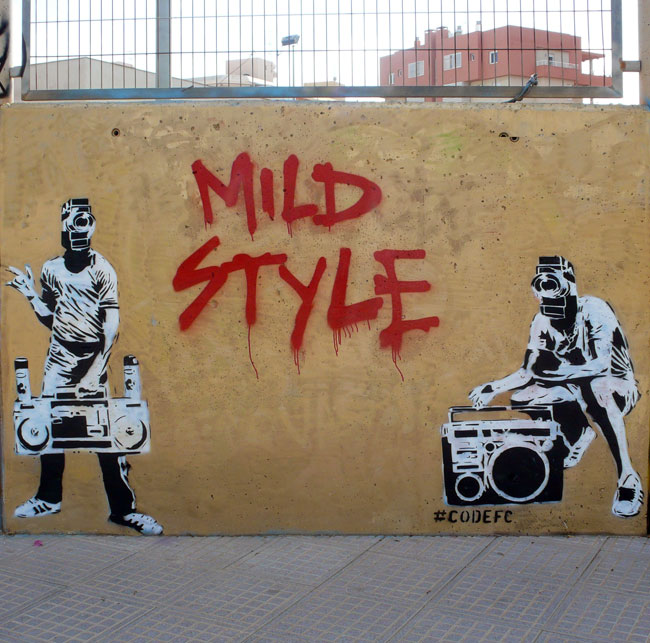
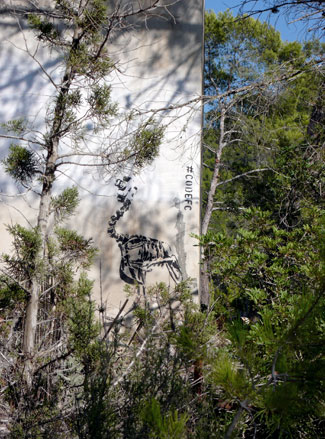
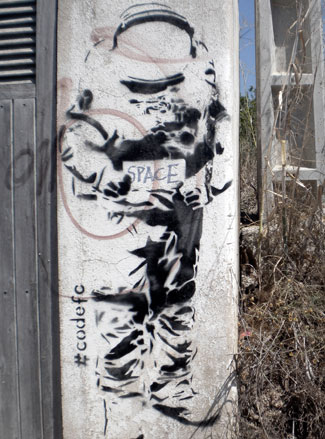
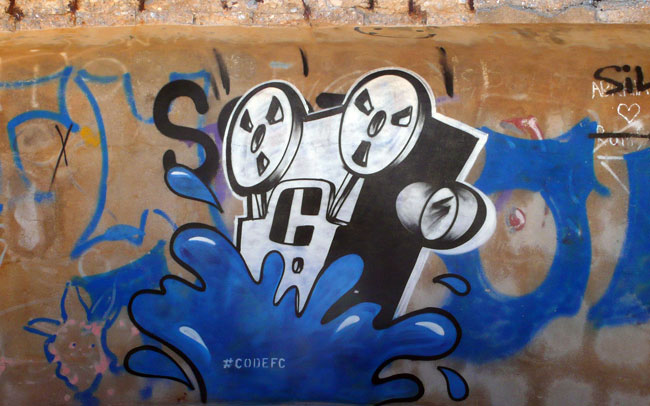
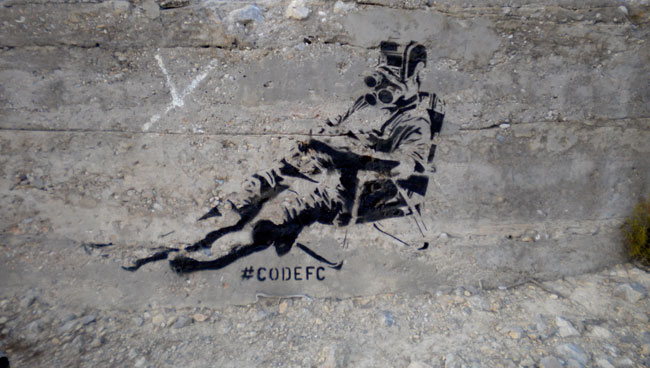
Codefc has just come back from Ibiza where he spent a few weeks (what?!). He obviously took the opportunity to leave his marks on a few surfaces and kindly sent us a few pictures of his work.
We have had to wait for three years but it is now upon us – “Fragile”, the new solo show by Dan Baldwin is opening tomorrow to the publich at Gallery 8. We hear that the artist will explore the concepts of mortality and beauty. As always, the new works by Dan Baldwin promise to be distinctively colourful defying categorisation as figurative or abstract, real or imaginary.
For those not so familiar with Dan Baldwin’s works, expect encompassing ceramics, silkscreen prints, resin, acrylics, spray paint and found objects carefully mixed together and resulting in complex and intricate pieces. It is also worth to point out that most of the objects in his uses have been collected since he was a child.
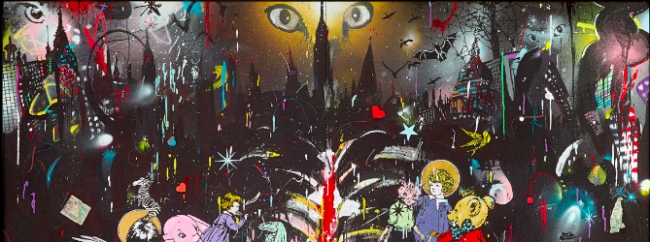
Big City
The show will present another set of large-scale acrylic works where the artist continue the exploration of symbolism and narrative. By contrast, the artist has also developed a series of abstract canvasses which are devoid of any motifs but instead explore further his fascination with colour harmony. In comparison to others in the exhibition, these works evoke a positive response in the viewer but still ask us to consider the uncertain and short-lived nature of human happiness.
Sacrilegium – click to enlarge
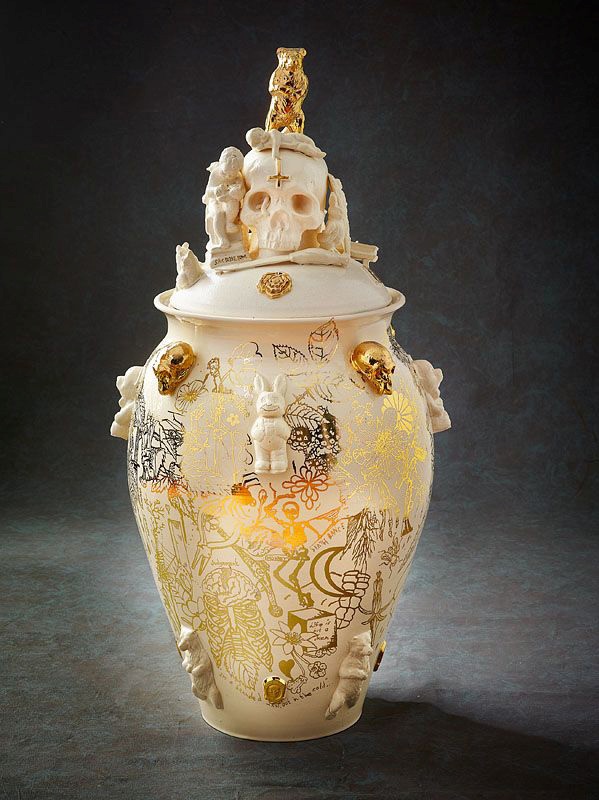
A large proportion of the show will be dedicated to a series of delicate ceramics, a medium with which the artist has started to experiment further in recent years. Now working with a Sicilian pottery workshop, the artist is creating increasingly elaborate urn-like vessels which are representative of death and the fleeting nature of our existence. The most ambitious to date is perhaps “Sacrilegium” (2013) which is adorned with a real human skull cast in clay as well as 20% pure gold paint, crucifix, cherubs and an antique Russian bear figurine. These motifs increase the funerary connotations of the object, making it appear fragile in more ways than one.
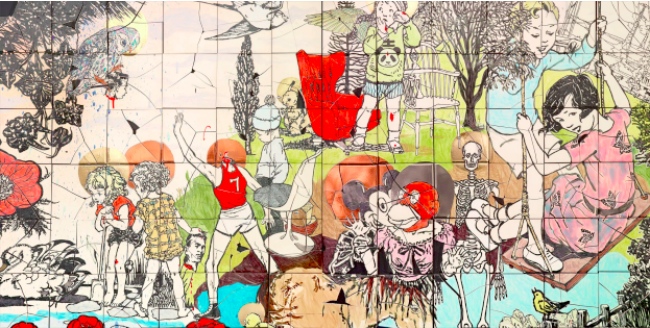
But Dan Baldwin’s exploration of new mediums in his art does not stop here. He has also developed a series of large-scale tile paintings for the exhibition. “The Picnic” (2012), for example, is made up of 96 tiles overlaid with several glazes and precious metals. The dreamlike scene is filled with juxtapositions of life and death, innocence and corruption; children play with a severed head whilst Mickey Mouse dances with a skeleton. In a final act of ‘iconoclasm’ the artist smashed the tiles before assembling them, to demonstrate their fragility
The Picnic
What – “Fragile” the new solo show by Dan Baldwin Where – Gallery 8 When – 20/9 till 5/10/2013 (private view on the 19/9)
Peripheral Vision, (c)2010 David Minton, oil on canvas
But it may be that without meaning there is only space, so in a sense I make my paintings by accident, but knowingly so. The central space created by painting ‘at the periphery’ has a tension that is constantly pregnant with possibility. In order to remain so, the tensions of space are never resolved, but continue and it is this continued lack of resolution that forms the overall content of the picture.[1] Perhaps what’s missing is what’s outside that loop or the fear of its ceasing to be a loop and become something that runs forward in time. All those fears and hopes, everything the intimacy within the home brings, begins to open up to a greater loss and eventually time will bring the loss of things because of the infinite nature of time; everything outside of time is infinite.[2]
At art college we were encouraged to self-analyse our output and I found myself not fully understanding how I travelled from initial concept to final outcome. So, now I find it useful to think of myself as a black box where every new line of enquiry has the potential to reveal more of my inner (often hidden) self and my motivations for doing what I do.[3] Initially it was very important to move away from outward observation, it came out of necessity for me, and I had to close myself off from the real world for a while although outward observation is creeping back into the work acting as little anchors.[4] All that is visible is a barely responsive exterior… This indifference, characteristic to the figures in my paintings, suggests the social is almost taken away. You wonder what is revealed in this state of consciousness, just mindless projections on to others perhaps.[5]
Woman with Cardigan, (c)2010 Melanie Titmuss, oil on canvas
This play on words, mixing up sentences from each artist interviewed so far for This ‘Me’ of Mine, is not intended as a clever ploy at meaning-making, but rather a look at the interconnectedness of the issues of the self and identity. Each of these artists is concerned in their own way with issues of self in their work. It is fascinating for me as curator to see how their concerns link together in the universal struggle to self-identify; something which I hope will become evident through these interviews.
Join us in the on-going discussions. Go to INTERVIEWS at the This ‘Me’ of Mine blogsite to read more from David Minton, Anthony Boswell, David Riley, Aly Helyer and Melanie Titmuss, the artists interviewed and quoted above (see credits below for links to the individual interviews).
Interviews coming up: Sarah Hervey, Shireen Qureshi and Sandra Crisp. Waiting in the wings: Kate Murdoch, Annabel Dover, Edd Pearman, Cathy Lomax, Hayley Harrison, and Darren Nixon. Art Historian and critic, Becky Huff Hunter, is kindly interviewing me and that will be coming up too.