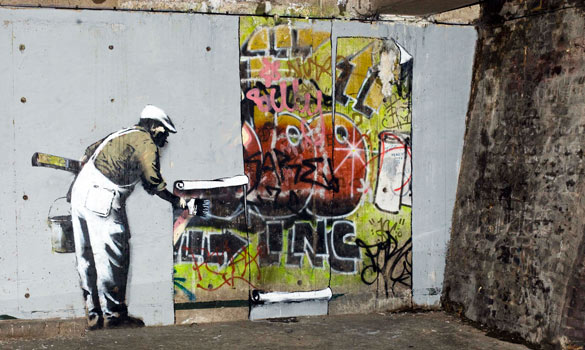
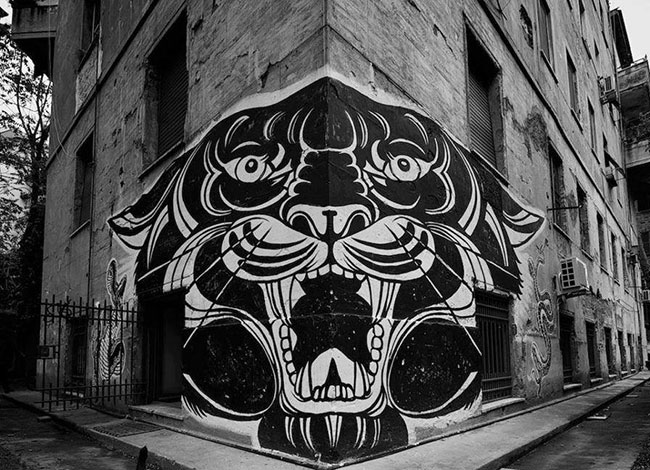
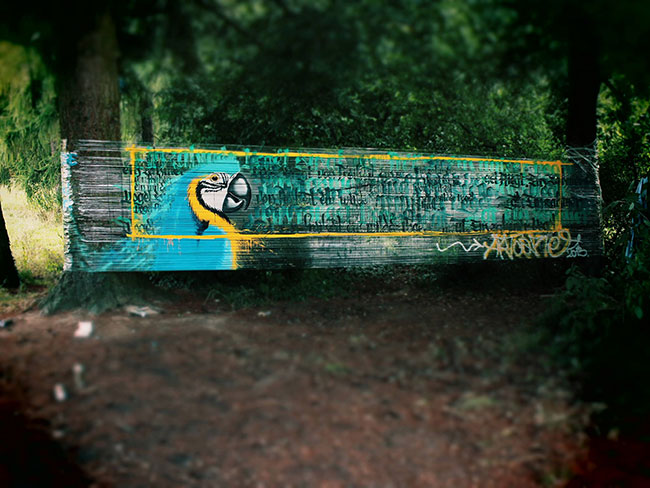
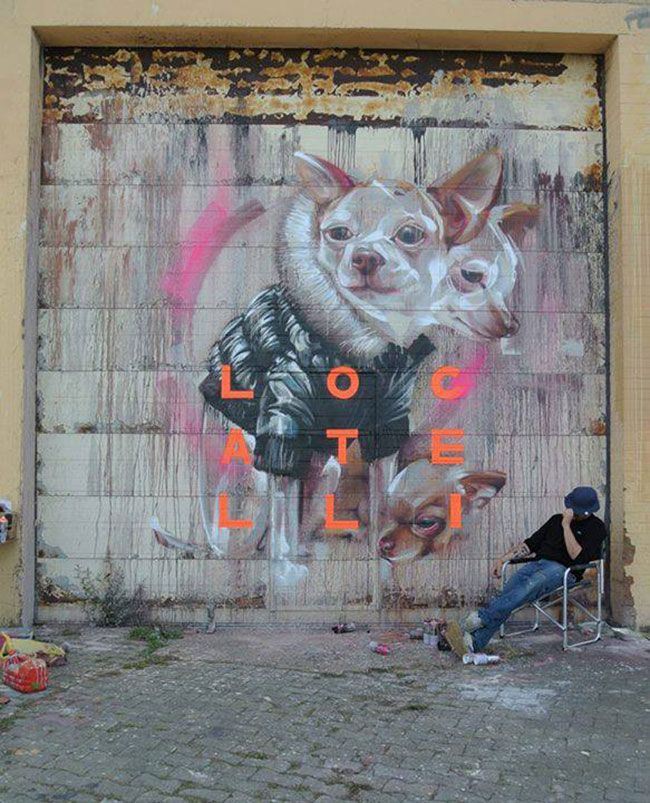
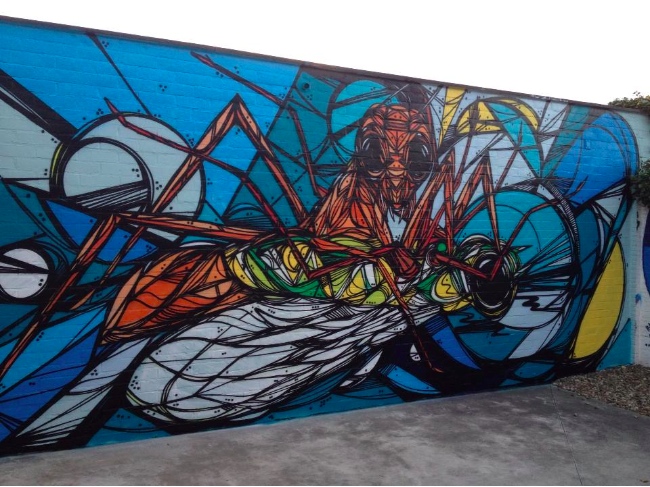
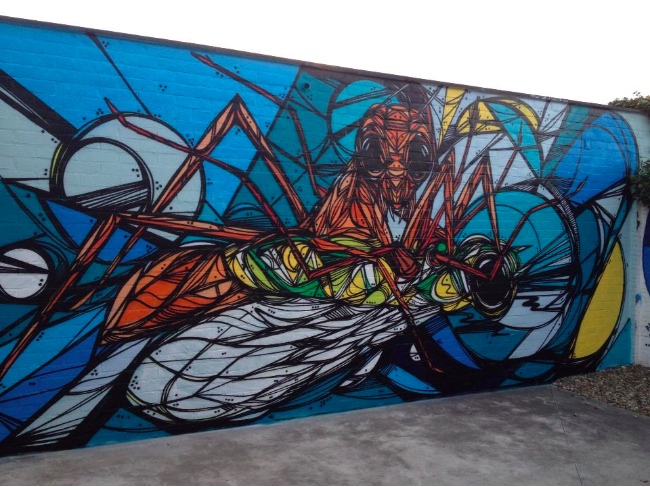
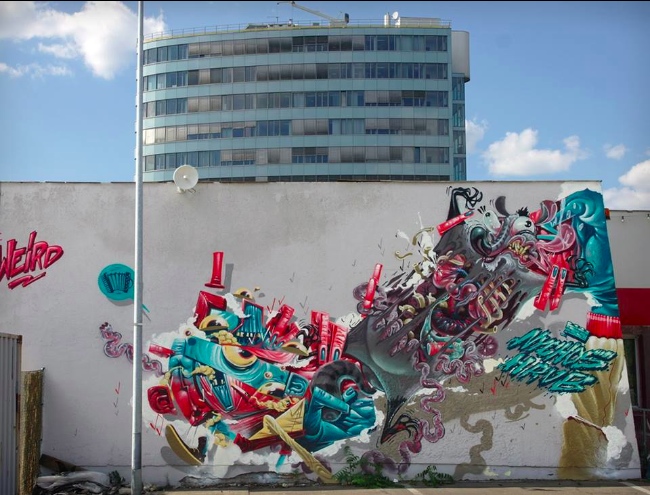
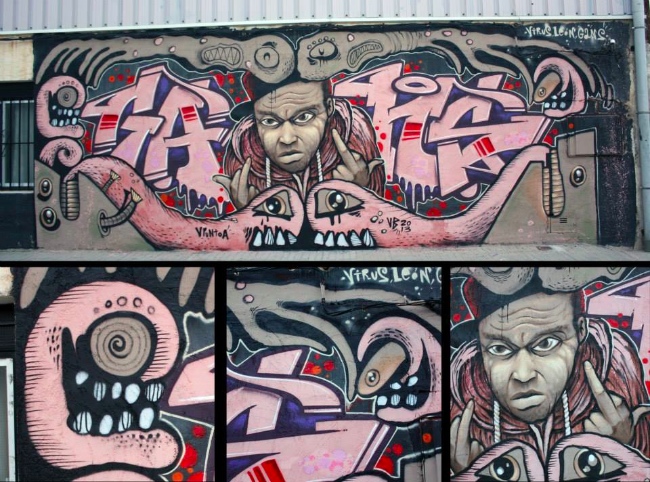
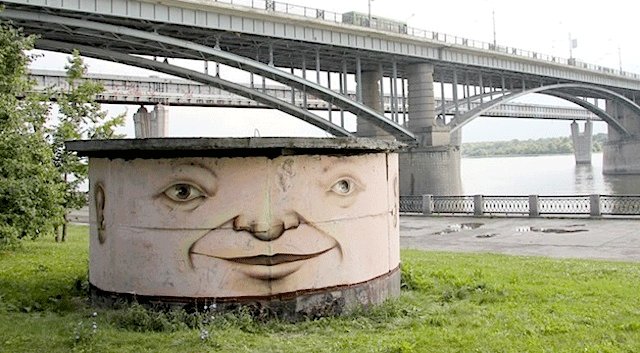
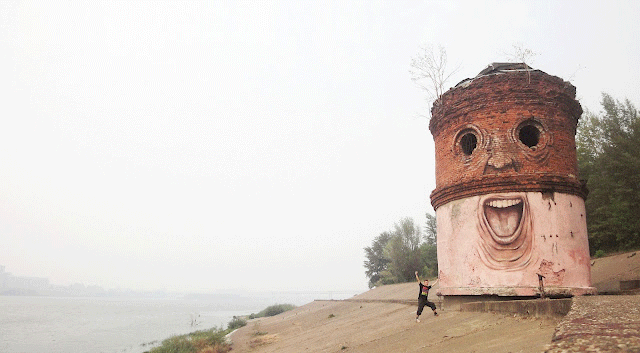
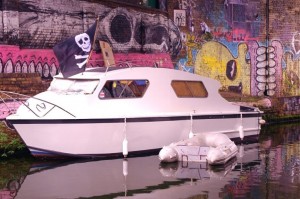
I like walking down the Regent’s canal, just for a stroll but also to spot street art. Many famous street or graffiti artists such as Banksky or Team Robbo have let their spray cans go wild on the walls of the surrounding buildings or bridges along the path.
Come to the canal this summer and get away from the Olympics madness and enjoy art, from performances, visual art to music. The Regent’s canal festival will be held from the 13 to the 15th July 2012. The submissions are being taken right now and until the 10th June 2012 so hurry and get this once in a lifetime opportunity.
“Regent’s Canal Festival celebrates the 200th anniversary of the formation of the Canal, while engaging local communities provides an excellent platform to deliver a wide range of artistic disciplines – such as audiovisuals, performances, visual arts, live experiences, events and music.
The Regent’s Canal Festival is taking place alongside the canal, crossing boroughs from Little Venice to Limehouse Basin. The Festival will be transforming the Regent’s Canal into an artistic and cultural hub raising awareness of environmental issues through the arts.
In order to create this, we are looking for art works that thematically fits our artistic vision, enhancing the look and feel of being surrounded by water.
The pieces may be interactive or purely visual spectacles, they can potentially incorporate elements of water or fire but they must be relatively durable and suitable for all weather conditions. Floating and light sculptures are particularly welcome.”
This application is most applicable to existing art works that you would like to exhibit to a wider audience. But if you have a new project that you like to create for the Festival don’t forget to send all the budget details.”
Deadline for project submission: Friday 1st June, 10pm
If you are interested in hearing about the upcoming programme of the Regent’s Canal Festival please emailinfo@regentscanalfestival.org.ukto join our mailing list.
“It is undoubtedly continuity which defines the compossibility of each world; and if the real world is the best, this is to the extent that it presents a maximum of continuity in a maximum number of cases, in a maximum number of relations and distinctive points.” Gilles Deleuze
This quote by Deleuze is a very complex statement on a very natural state of continuity and it is a state we are becoming readily familiar with through social media communication. Simply put, at the centre of each ‘world’, which is each of us, is collected a series of things (perceptions, object, memories, experiences etc.) which expands in all directions colliding and mingling with other worlds, (everyone else). This mingling is compossibility and we are fast becoming experts in it without really realising it.
This statement also suggests that our perceptions now are being formed by more than direct sensory experiences but also by data input in a compossible world, a world we don’t actually experience first-hand, but by proxy through the experience of others. The trouble with this is we are easily fooled, as discussed in ‘How fake images change our memories and behaviour’ by Rose Eveleth for the BBC’s Future magazine.
In my interview with Sandra Crisp, Memory Surfaces, I asked her about the implications of Deleuze’s statement:
JB:“It is undoubtedly continuity which defines the compossibility of each world; and if the real world is the best, this is to the extent that it presents a maximum of continuity in a maximum number of cases, in a maximum number of relations and distinctive points.”[1] This quote by Gilles Deleuze from Difference and Repetition suggests it’s a collective consciousness in perception which allows us to comprehend our world, do you feel our digital age helps or hinders our sense of continuity (memory) and ultimately our sense of self when information appears and disappears so rapidly online? Is it possible this rapid change in information thrusts us back into the ‘truth’ of physicality?
SC: What we have online at the moment is the continuous and rapid shift of information: Text, images, video and even entire web pages suddenly appearing then disappearing. Deletions with no warning – error 404 messages: ‘Page not Found’. Continual updates; all these create a sense of fragmentation and impermanence, and discontinuity. Printed books in the physical world are fixed and unchanging, we can rely on their information stability, each time we take them from the shelf they are the same as before. So this state of information transience is very much a modern phenomenon connected to the information age. In the past, a shift from oral to book cultures required people to process information differently; today many people now communicate and receive information via TV, radio, and Internet, electronic media rather than books. Therefore, I am not sure that any more ‘truth’ can be said to reside in the physical world than virtual, that this is any more contiguous. As with any new technology, it will change us and we need to learn how to use such new communication media wisely, to adapt to the apparent discontinuity, to interact with, and process the information bombarding us in meaningful ways. At the moment digital online communication is nascent, we are living in really interesting times where things are still developing. At the moment it may thrust us back into the continuity of the physical world but eventually in the future it may not.
You can find this exchange with Sandra in the full version of our interview, available in the This ‘Me’ of Mine companion book. Find out more about the book on our blogsite. Read our excerpted interview here.
[1] Difference and Repetition, Giles Deleuze, Continuum Books, 2004, pg.58
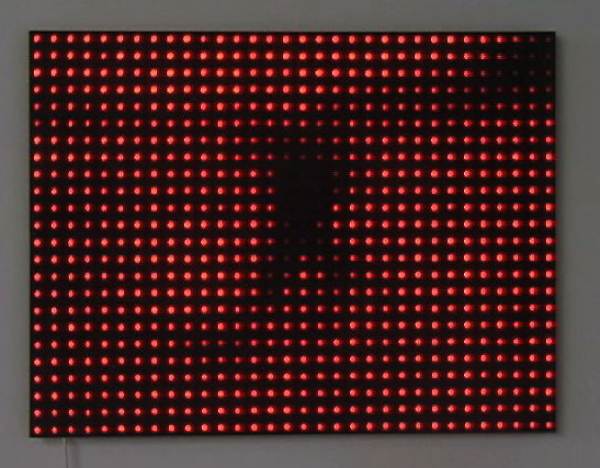
A man runs. He falls down. He struggles back onto his feet and he runs some more. It’s a simple narrative. Even without much detail, you can understand what’s going on. Pause the video, though, and the scene isn’t nearly as clear. Movement makes up for the lack of other visual information. Your brain can read and understand a video at much lower resolution than it would need to make equal sense of a still frame.
Meet Jim Campbell, a former Silicon Valley engineer turned visual artist. Inspired by early Bell Labs experiments with pixelated images, and by his own engineering work with digital filters, Campbell makes art that toys with the human brain.
The Big Egg Hunt was a plan hatched by Elephant Family and Action for Children for a record-breaking egg hunt across Central London to raise money for these two eggshell-ent causes!
Over 200 uniquely crafted eggs, created by leading artists, designers, architects and jewellers, will be hidden across the capital this Easter. Get onto the www.thebigegghunt.co.uk for the full details and collect your map and download the app. All eggs are also up for auction.
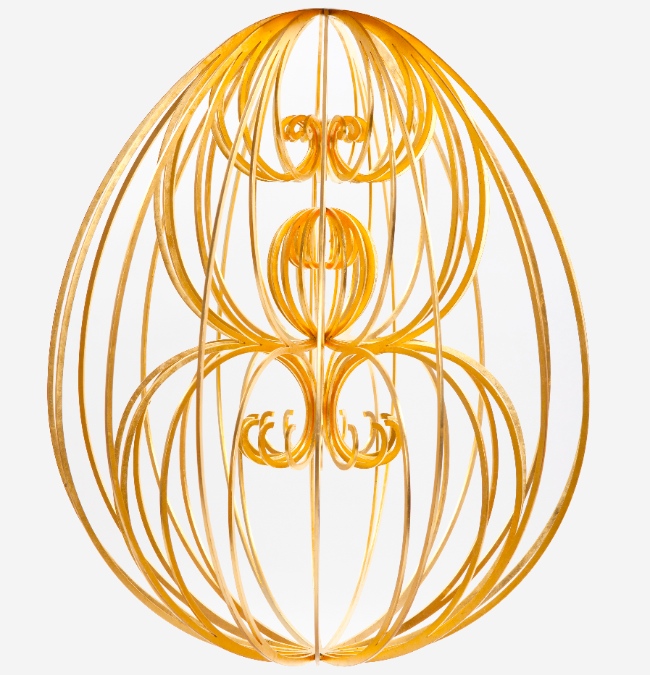
An impressive bunch of artists are taking part and have crafted their own egg. Just to mention a few – Nick & Rob Carter, The Chapman Brothers, Anony Micallef. But the focus will be here on Nathalie Priem’s egg creation – a superb egg made of steel and gilded in 23.5 carat gold! (photo included below)
> Get bidding to make sure to get Nathalie’s Priem’s egg!
The artist, with the help of Wooden Horse London (www.woodenhorselondon.com), a new bespoke design and fabrication company in Hackney, is what she says about her artwork:
“The Golden Egg was born from my desire to understand where and how beauty is perceived in the artefacts we create. Stemming from an interest in the human need to create pleasing visual proportions within the things we construct and the seemingly contrasting chaotic driving forces of nature, the Golden egg is an example of mathematics within nature, and nature within rigid form. Built upon the Fibonacci series and the golden ratio, every curve within the Golden Egg portrays both precision and elegance. It looks to demonstrate that the inventions of mankind will always be dictated to by nature, a beautiful framework within which we are all held.”
Catlin Art Prize (www.artcatlin.com)
When: Wednesday 16 April 2012
Where: Londonnewcastle Project Space, London, E2 7DP
The winner of the 2012 Catlin Art Prize is Julia Vogl, a 2011 graduate of the Slade School of Fine Art at University College London. She is the sixth winner of the annual Catlin Art Prize, a competition showcasing the work of recent graduates of UK art schools.
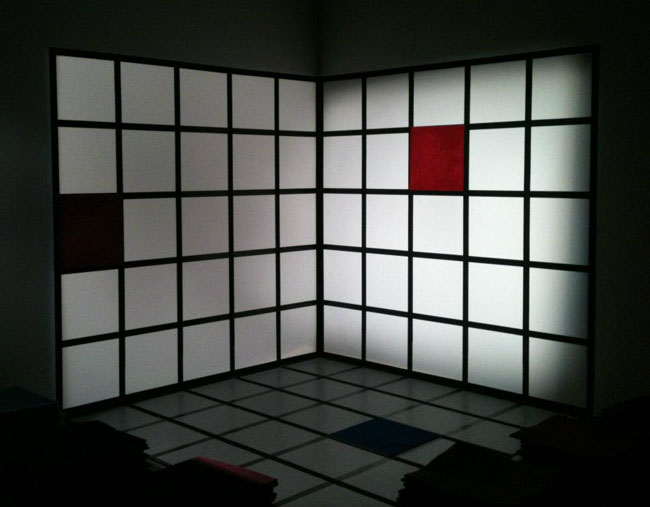
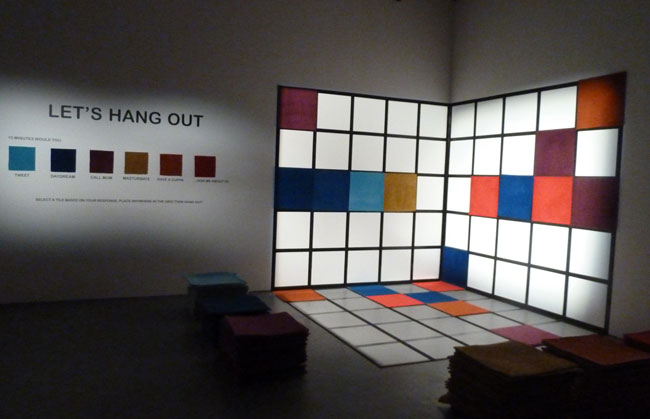
Julia Vogl won the 2012 Catlin Art Prize for her ‘social sculpture’titled ‘Let’s Hang Out’. The work invites visitors to create a communal area by selecting and affixing coloured carpet titles that colour-correspond with Julia’s suggestions of various pastimes (such as ‘call Mum’, ‘tweet’, etc.). The work will evolve throughout the duration of the Catlin Art Prize exhibition while encouraging visitors to interact – and hang out.”
The official comments on the Art Catlin website confirming the recipient of the £5,000 award, now it its 6th year.
The exhibition showcasing the finalists of the artists compiled in the Catlin Guide was hosted at the Londonnewcastle project space and in my opinion was laid out and staged to create an explorative feeling when entering.
Before hearing the winner I was one of the first people to interact with Julia’s “lets hang out” and felt that for me this was quite rightly a centre piece, seemingly the concensus as it turned out.
In addition to film and other mixed media work the next most enjoyable piece was marbles and sand staged in one of the corners of the show. A mystical and engaging feeling from starting at the work and felt very much similar to my own thoughts on moments in time.
The second piece which was a stuffed horse on its back clamping on to a made object. This was very striking but wasted on me.
The guide is fast becoming as much a tool for collectors as it is for the artworld in showcasing talent and clamouring for the prize.
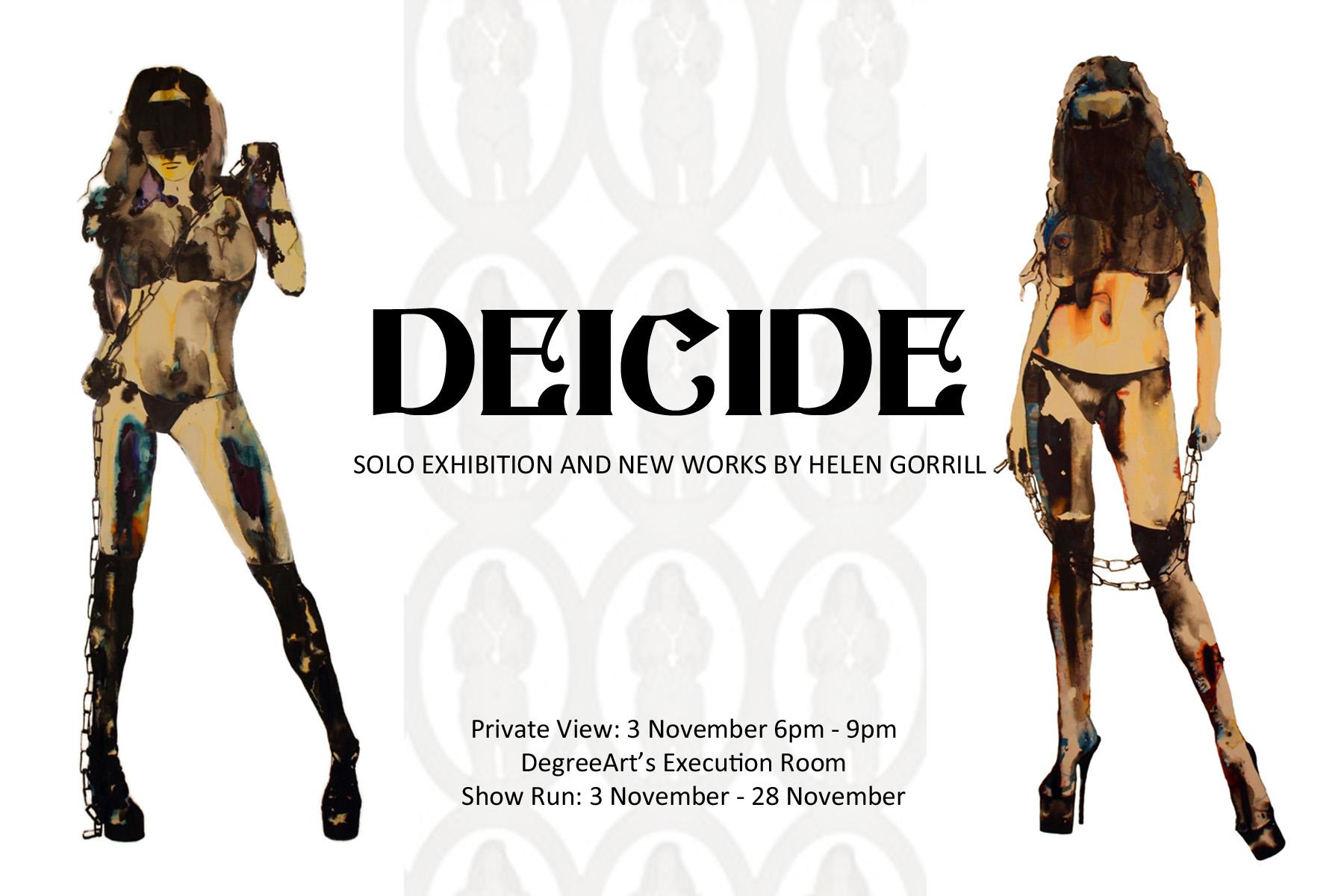
Saturday 26 November I made way to Degree Art’s gallery on Vyner Street to view the works of Helen Gorrill on show in the solo exhibition titled DEICIDE. The gallery is not so far away from Bethnal Green as people might think and a fair pace will get you to the gallery in 10 minutes.
Upon arrival to the gallery I chatted with gallery manager (and all round arts, culture & fashion voice) Ryan Lanji who gave me a few pointers about the show, which I had not picked up on from my brief musings online. The first of which being the portrait of a Pope which was attached to the floor at the entrance of the gallery; meaning that everyone that enters walks over the Pope – a sign of the conflict with sexuality and religion which appears a central aspect in Helen’s work.
Degree Art Gallery Manager, Ryan Lanji
After which Ryan explained about the Confession Chamber which was the interactive element of Helen’s work; a look at the notion of confession, who to and why. Within the chamber, which has been meticulously created to represent a real confession box, are confessions from every body that has entered, along with some well know confessors from the art world. Some of which have been stitched into the fabric of the inside, some written in chalk on the walls and some placed in envelopes on the wall. Everybody was encouraged to enter there own confessions…
The last point we covered, which really was not apparent with the online material was the sheer size of Helen’s work. I had imagined them to be water colour pieces which would look great in a plain white frame and would be of reasonable size to go above the fire place, hang in the dining room or be a centre piece for the spare room. I did not for one minute imagine them to be the slightly oversized real life height that they are!
The reason for this as I found out when talking with Helen is intertwined within the whole body of work. The role reversal; the woman in charge, the woman in power, the woman imposing in height standing above the crouched, submissive man.
Ryan Lanji and Helen Gorrill
Helen’s work was hung from chains on the ceiling to allow for the full effect of the size to be felt. They covered the main walls of the gallery and in my opinion are hard to find fault with in terms of the concept. Secured to the floor were 3 images of men in submissive postions, all positioned under the images of the women. In addition to this there was Helen’s provocative installation pieces which are steeped in religious references as well as a swipe at the controlling nature of the Church.
Helen’s background is that of an interesting mix of religion and control. A Christian background, a marriage to a Policeman who was also a Jehovah’s Witness and a seeming questioning of the effect of male influence in her life and choices. One of Helen’s shows was censored; the male nudity was covered but the female nudity was not – a very interesting point, especially as it was censored by men. This also questions the influence that men have had over society and the extent of control over what social acceptances should be. Helen’s work was actually featured on a Vatican sponsored website for some time because they thought it was promoting the Confession – when they realised it was actually asking a few more questions it was promptly removed!
Listening to Helen reference sexuality, feminism and religion in her work was very compelling in considering whether this is just a result of Helen’s personal experience or is a genuine perception of the world which many of us overlook or choose to ignore. Helen was supported by Degree Art’s very own Chloe Lawrence who covered some points in
literature relating to the feminist cause and the response this drew from female artists. References to Yoko Ono’s “Cut Piece”, Carole Schneemann’s “Interior Scroll” and Judy Chicago’s “Dinner Party” were all made. In addition we also heard from Kim Foxton who spoke about religion and the role of women through history and how this has changed.
Ryan Lanji, Helen Gorrill, Chloe Lawrence & Kim Foxton
Questions from the audience as well as Degree Art Founders Elinor Olisa & Isobel Beauchamp followed and this evolved to more personal discussions with the speakers accompanied with refreshments.
Overall a very well put together show which had important questions to state, as well as what I felt were aesthetically pleasing works. A great
environment to discuss the work and a well chosen line up of supporting speakers made a very enjoyable ‘art evening’.
Information
The provocative solo show ran from 3 November to 28 November 2011 with an evening in conversation with the artist on Saturday 26 November 2011.
What Nikita Nomerz needs to make his art are walls but not just any wall. His preference goes towards dilapidates ones with broken windows or any sort of holes which he will use in his compositions often depicting a laughing face.
Along a few pictures of his work, I have included below a time lapse video which shows Nikita Nomerz painting one of his now recognizable face somewhere in Russia
He says: “I started in school with classic hip hop graffiti but became more interested in street art and began all sorts of experiments. Now basically I like to play with space and objects. I am inspired by the place itself. I love watching the city and finding an interesting point. Usually I do not spend so much time to create one work, sometimes less than an hour. But it all depends on the size of the object and my ideas. (source: The Telegraph)

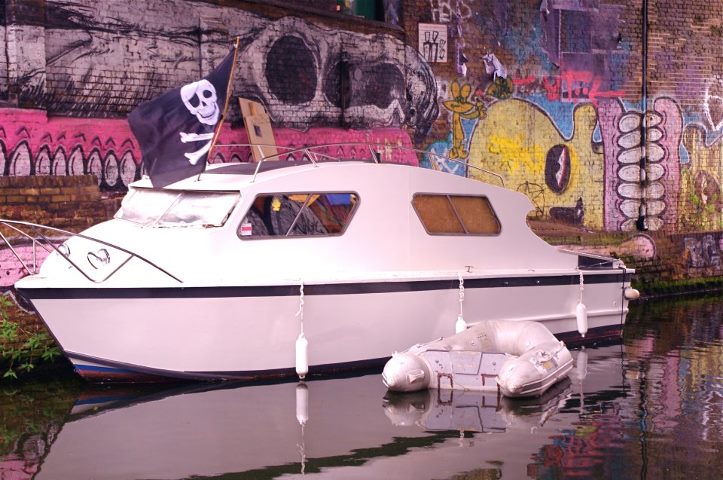
 I like walking down the Regent’s canal, just for a stroll but also to spot street art. Many famous street or graffiti artists such as Banksky or Team Robbo have let their spray cans go wild on the walls of the surrounding buildings or bridges along the path.
 This application is most applicable to existing art works that you would like to exhibit to a wider audience. But if you have a new project that you like to create for the Festival don’t forget to send all the budget details.”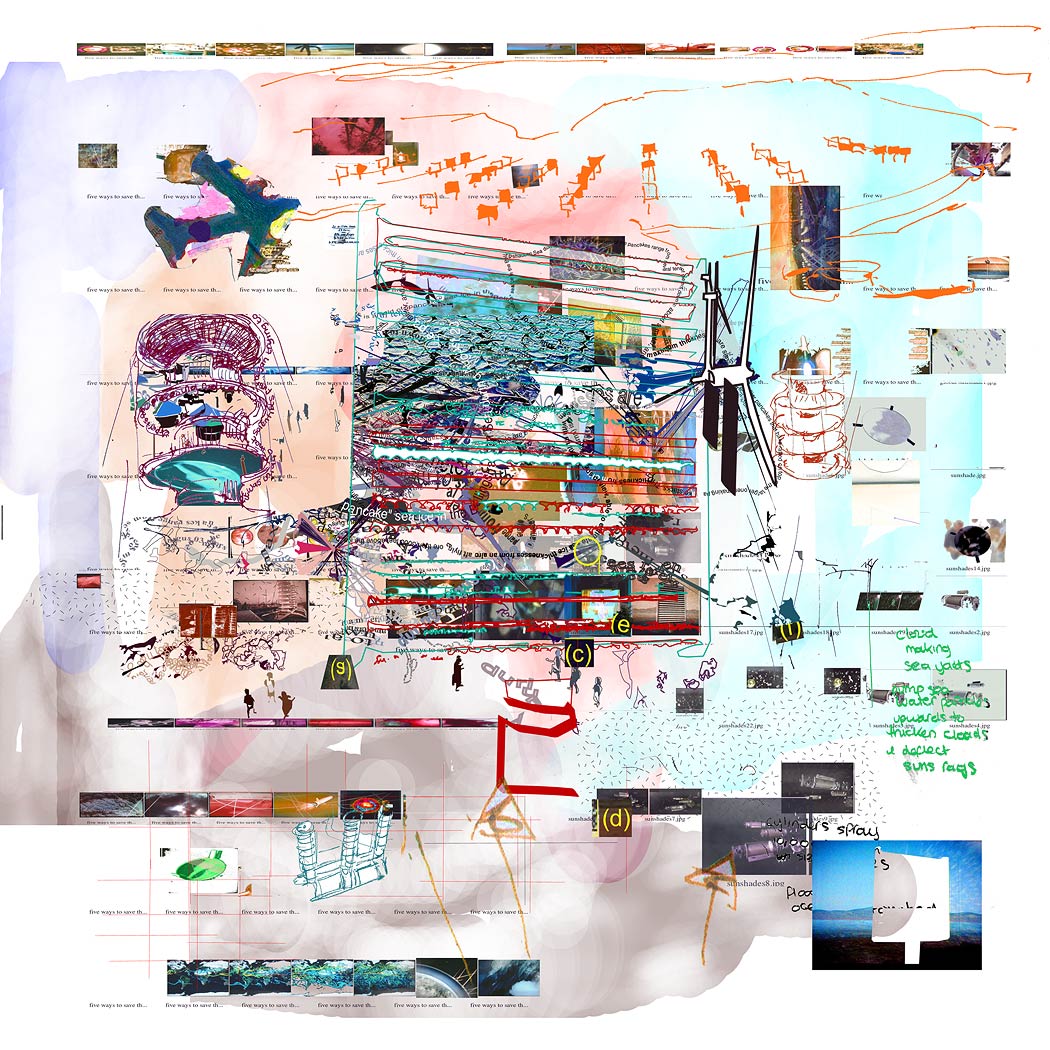
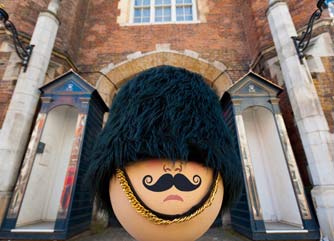 The Big Egg Hunt was a plan hatched by Elephant Family and Action for Children for a record-breaking egg hunt across Central London to raise money for these two eggshell-ent causes!