Compossible Worlds

“It is undoubtedly continuity which defines the compossibility of each world; and if the real world is the best, this is to the extent that it presents a maximum of continuity in a maximum number of cases, in a maximum number of relations and distinctive points.”                                                      Gilles Deleuze

Diagram (artificial tree), 2010 Sandra Crisp
Diagram (artificial tree), © 2010 Sandra Crisp, Ink Jet Print

This quote by Deleuze is a very complex statement on a very natural state of continuity and it is a state we are becoming readily familiar with through social media communication. Simply put, at the centre of each ‘world’, which is each of us, is collected a series of things (perceptions, object, memories, experiences etc.) which expands in all directions colliding and mingling with other worlds, (everyone else). This mingling is compossibility and we are fast becoming experts in it without really realising it.

This statement also suggests that our perceptions now are being formed by more than direct sensory experiences but also by data input in a compossible world, a world we don’t actually experience first-hand, but by proxy through the experience of others. The trouble with this is we are easily fooled, as discussed in ‘How fake images change our memories and behaviour’ by Rose Eveleth for the BBC’s Future magazine.

In my interview with Sandra Crisp, Memory Surfaces, I asked her about the implications of Deleuze’s statement:

JB: “It is undoubtedly continuity which defines the compossibility of each world; and if the real world is the best, this is to the extent that it presents a maximum of continuity in a maximum number of cases, in a maximum number of relations and distinctive points.”[1] This quote by Gilles Deleuze from Difference and Repetition suggests it’s a collective consciousness in perception which allows us to comprehend our world, do you feel our digital age helps or hinders our sense of continuity (memory) and ultimately our sense of self when information appears and disappears so rapidly online?  Is it possible this rapid change in information thrusts us back into the ‘truth’ of physicality?

SC: What we have online at the moment is the continuous and rapid shift of information: Text, images, video and even entire web pages suddenly appearing then disappearing. Deletions with no warning – error 404 messages: ‘Page not Found’. Continual updates; all these create a sense of fragmentation and impermanence, and discontinuity. Printed books in the physical world are fixed and unchanging, we can rely on their information stability, each time we take them from the shelf they are the same as before. So this state of information transience is very much a modern phenomenon connected to the information age. In the past, a shift from oral to book cultures required people to process information differently; today many people now communicate and receive information via TV, radio, and Internet, electronic media rather than books. Therefore, I am not sure that any more ‘truth’ can be said to reside in the physical world than virtual, that this is any more contiguous. As with any new technology, it will change us and we need to learn how to use such new communication media wisely, to adapt to the apparent discontinuity, to interact with, and process the information bombarding us in meaningful ways. At the moment digital online communication is nascent, we are living in really interesting times where things are still developing. At the moment it may thrust us back into the continuity of the physical world but eventually in the future it may not.

You can find this exchange with Sandra in the full version of our interview, available in the This ‘Me’ of Mine companion book. Find out more about the book on our blogsite. Read our excerpted interview here.


[1] Difference and Repetition, Giles Deleuze, Continuum Books, 2004, pg.58

Dave white new show “sold out” at Lock Studios

Loughran Gallery is treating us big time with Dave White new show “Sold out”, they are treating us not just because the show is a retrospective  show which features some incredibly special exclusives from the artist but also because the venue, Lock Studios, is simply awesome.

We were treated with cocktails and canapes all night. We did manage to snap a few pics that you can see below.

“Sold Out”, Dave White new show at Lock Studios is now over.

Dave White at Lock Studios | Art-Pie
Dave White at Lock Studios | Art-PieDave White at Lock Studios | Art-Pie
Dave White at Lock Studios | Art-Pie

100,000 LED lights to light up the Sumida River

Tokyo has always been a mistery to me, one of these cities that will you blow away for sure. What follows would certainly water my eyes. At the occasion of the Tokyo Hotaru festival that just happened, one of a kind of installation was made where LED lights were the main ingredient. LED lights are awesome, aren’t they?

100,000 LED lights, that is what it took to give to the onlookers an astonishing spectacle. The aim here was to suggest hotaru (fireflies) with those lights that floated down the Sumida River through central Tokyo.

Beyond the purdy effect, let’s note that the LEDs were  designed to light up upon contact with water and were 100% powered by solar energy. Let’s also mention the reference to a long gone practice were people used to to gather, it seems,  around clean, running water, searching for these luminous creatures.

First seen on www.spoon-tamago.com. All credits to the pictures below can be found on this website

ART-PIE - Hotaru festival

ART-PIE - Hotaru festival

ART-PIE - Hotaru festival

Ross M Brown’s solo exhibition CONCRETE MYTHS

Ross M Brown has a new solo exhibition at Lacey Contemporary Gallery called – Concrete Myths.

This new body of work was created following a research trip to the derelict Haludovo Palace Hotel on Kirk Island, a 1970s luxury resort designed by Modernist architect Boris Magas.

Brown depicts the dilapidated location in a series of large scale paintings that often reference formal tropes more commonly associated with Modernist abstraction.


CONCRETE MYTHS – Ross M Brown  | Art-PieRoss M Brown’s work channels the experience of architectural space through the medium and history of painting.  Exploring subject matter found within abandoned Modernist architecture, the artist layers disparate approaches from the history of painting producing a palimpsest of diverging and converging painterly approaches.

Relating to the urban ruin as a hybrid space where divisions between past and present, architecture and nature, order and disorder have become blurred and indistinct, Brown employs a painting process which pits rigidly constructed perspective against the fluid materiality of poured, smeared and dripped paint.

WHAT – Concrete Myths by Ross M Brown
WHERE – Lacey Contemporary gallery, 8 Clarendon Cross, London W11 4AP
WHEN – 17th June (preview) till 4th July 2015

London Art fair – in its 23rd year but still going strong, part3

So there we had it – the 23rd London art fair, the biggest yet with a remarkable 24 ooo+ visitors this year. It has proven to me that this event is the place or one of the best places to discover, see or enjoy the best of modern and contemporary British art.

Over 120 galleries exhibited this year,  a decent number but still lagging behind its big sister, the Frieze art fair, with its 170+ galleries  but the two events should maybe not be compared as the Frieze fair is an international fair while the London art fair focusing on British art.

Another noticeable thing was that this year again, London based galleries made the bulk of the exhibitors with 80%. Painting and sculpture were also again the two main types of arts that could be seen but this is what the London Art Fair (LAF) has been about for a while now. The regular visitor will know this, the newbies not necessarily.

Selected works from the fair below.

William Martyr
Acrylics on canvas | Tag Fine Arts

Paul wright
Oil on canvas | Thompson gallery

John Hoylan
Acrylics on cotton duck | Beaux Arts London

Andrea Mastrovito
Cut paper collage and aniline dye on paper | Foley gallery

Dominic Shepperd
Oil on canvas | Charlie Smith

Marilene Oliver
Laser prints on card, red ink, bonded nylon and seed beads | Beaux Arts London

Noise project – Challenge #1 The Pulse

We announced a little while ago that we were part of the Noise Intercepted project, a global art project curated by Labspace Studio (a creative agency & art house in Toronto, Canada). Noise Intercepted is a series of ten experience-activated noise challenges that prompt participants to listen, observe and interact with their urban soundscape in new and unlikely ways.

Challenge #1 is in and so is our entry – see below

Noise challenge #1: The Pulse

If your city had a defining sound, a defining pulse, a defining heartbeat, what would it sound like? look like? or feel like? …where would you go to find it? You have 1 week to venture outside and find the pulse of your city.

We thought for the obvious right away, we need to capture a sound, the pulse. And at night where sight is diminished by the darkness. But we were wrong, the pulse was visual. We started walking down the street trying to hear out for the pulse of the city but we found visual signs everywhere that we immediately associated to the pulse. We had found the pulse: the light.

Then focusing on the light, we sat back and listened and all sort of sound patters came to life. we had found the origin of the pulse: us, humans.

We make the pulse, we are the pulse of the city.

Guy Denning at Signal gallery – Paradiso

Bristol born artist, Guy Denning final part of his trilogy of exhibitions (It’s the final part of his trilogy of exhibitions interpreting Dante’s The Divine Comedy; PARADISO. Inferno and Purgatorio, which were shown in Bologna and New York) interpreting Dante’s The Divine Comedy: PARADISO has just happened at Signal gallery and has delighted us by his intensity and display of technical art skills.

Each piece in this show is boiling with emotions and dynamism and mirror the ecstatic route to a place of resolution and rest for Dante, the route to heaven that is for Dante.

Guy Denning - Paradiso | Art-Pie

A quite large part of the show present a series of female portraits appearing soft and fragile but transposed in some sort of tragedy thanks to the sketchy technique used by the artist, although achieved mostly with oil which is remarkable. The artist inspiration comes from Beatrice, Dante’s long dead love, who is the central figure in the poem and who symbolises feminine purity and vulnerability.

Guy Denning - Paradiso | Art-Pie

Denning’s characters are floating, dancing, tangling with each other and give you a sense of dizziness. The color palette is dark and deep like the multitude faces expressions disseminated all over the canvases. The perspective used for some of his pieces is also remarkable and is an invitation to dive into his vision.

Guy Denning - Paradiso | Art-PieGuy Denning - Paradiso | Art-Pie

Guy Denning will definitely arouse the viewer’s curiosity about Dante’s life and has given us an unique and modern representation of Dante’s 14th century world.

The show is now over.

Guy Denning - Paradiso | Art-Pie

Guy Denning - Paradiso | Art-Pie

Guy Denning - Paradiso | Art-Pie

Guy Denning - Paradiso | Art-Pie

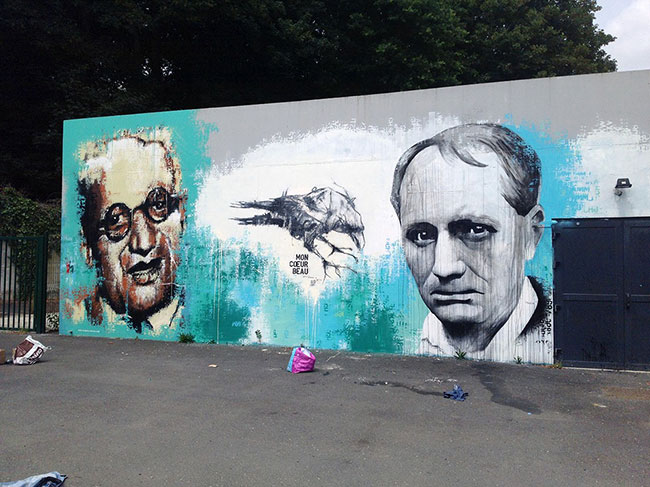
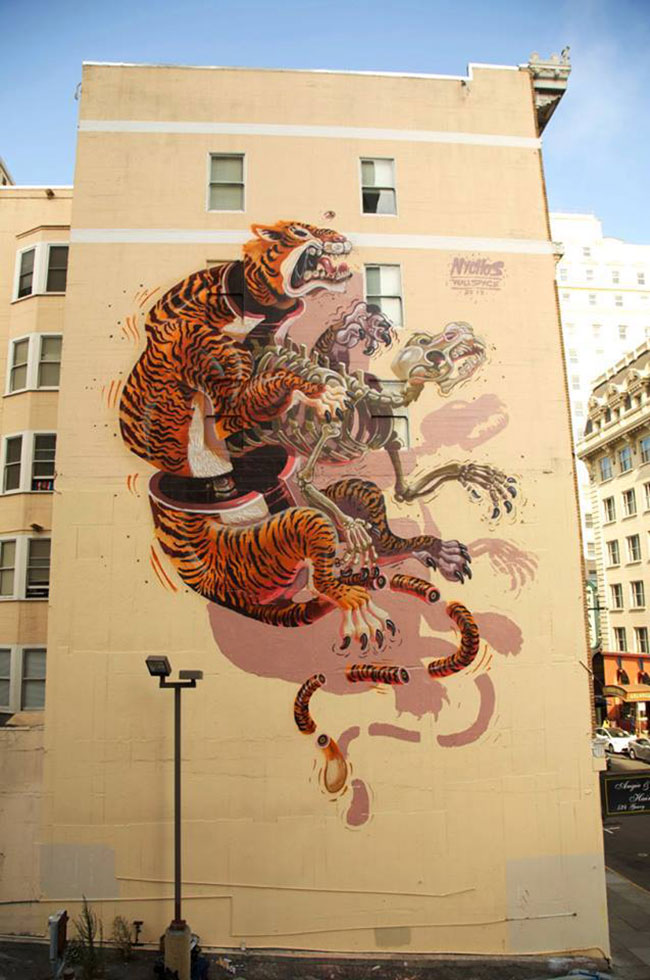
STREET ART ENCOUNTERS